
Congenital heart disease in adults
Conditions
Overview
Congenital heart disease in adults refers to changes in the heart's structure that are present at birth. These changes often are called congenital heart defects or congenital heart anomalies. Congenital means that you're born with the condition. In adults, the term "congenital heart disease" may be used.
This article focuses on congenital heart disease in adults. This includes people who know they were born with a heart condition and may or may not have had treatment. It also includes people who find out about their congenital heart condition as adults.
Congenital heart disease can change the way blood flows through the heart. This can cause symptoms such as shortness of breath and tiredness. Some people may have blue or gray skin if oxygen levels in the blood drop. This symptom may be harder to see in some skin colors.
Some types of congenital heart disease are mild. Others are life-threatening. But better treatments are now helping more people with congenital heart disease live longer.
Treatment for congenital heart disease may include regular health checkups, medicines or surgery. If you have adult congenital heart disease, it is important to have regular follow-up care even if you feel OK. Ask your healthcare team how often you need a checkup.
Types
Congenital heart disease may be grouped by how it affects the oxygen levels in the blood.
- Cyanotic congenital heart disease causes low oxygen levels in the blood.
- Acyanotic congenital heart disease usually does not cause a drop in oxygen levels in the blood.
Types of cyanotic congenital heart disease include:
- Hypoplastic left heart syndrome.
- Pulmonary atresia.
- Pulmonary atresia with intact ventricular septum.
- Pulmonary atresia with ventricular septal defect.
- Tetralogy of Fallot.
- Total anomalous pulmonary venous return (TAPVR).
- Transposition of the great arteries.
- Tricuspid atresia.
- Truncus arteriosus.
Types of acyanotic congenital heart disease include:
- Atrial septal defect (ASD).
- Atrioventricular canal defect.
- Bicuspid aortic valve.
- Coarctation of the aorta.
- Congenital mitral valve anomalies.
- Partial anomalous pulmonary venous return.
- Patent ductus arteriosus (PDA).
- Patent foramen ovale.
- Pulmonary valve stenosis.
- Ventricular septal defect (VSD).
Not all congenital heart conditions fit neatly into the cyanotic or acyanotic types. Some may cause low oxygen levels in the blood only in some situations. Examples of these types of congenital heart disease are:
- Ebstein anomaly.
- Vascular rings.
Congenital heart disease also may be grouped by how serious or complex the heart changes are.
- Critical congenital heart disease is a serious congenital heart defect that needs treatment early in life. Adults who were born with critical congenital heart disease may need more procedures or surgeries over time.
- Complex congenital heart disease means the heart has more complicated changes in its structure. Adults with complex congenital heart disease often need specialized lifelong care.
Symptoms
Some adults born with a congenital heart defect don't notice symptoms until later in life. Symptoms also may return years after the heart condition is treated.
Common congenital heart disease symptoms in adults include:
- Irregular heartbeats, also called arrhythmias.
- Blue or gray skin, lips and fingernails due to low oxygen levels. These color changes may be easier or harder to see depending on your skin color.
- Shortness of breath.
- Getting tired very quickly when you are active, even during everyday activities.
- Swelling in the legs, ankles, feet or belly caused by fluid buildup, called edema. This symptom may be a sign of heart failure.
Note: These symptoms can happen with other conditions. It is important to have a health checkup to learn the cause.
Congenital heart defects in children can cause other symptoms, such as trouble feeding, poor weight gain, fast breathing or sweating during feeds.
When to see a doctor
Get emergency medical help if you have unexplained chest pain or shortness of breath.
Make an appointment for a health checkup if:
- You have symptoms of adult congenital heart disease.
- You had treatment for a congenital heart defect as a child.
Causes
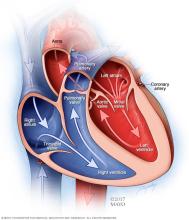
Researchers don't know what causes most types of congenital heart disease. Congenital heart disease happens as an unborn baby, also called a fetus, is growing in the womb during pregnancy.
Risk factors
A risk factor is something that raises the chance of a health condition. During pregnancy, some factors may raise the chance of congenital heart defects in a baby. Adults with congenital heart disease also may need to know about these risks if they plan to have a child.
- Genetics. Some congenital heart diseases run in families, which means they are inherited. An example is a bicuspid aortic valve. Some people have other gene changes that commonly happen with heart conditions present at birth. For instance, people with Down syndrome may be born with congenital heart disease.
- German measles, also called rubella. Having rubella during pregnancy may affect how the baby's heart grows while in the womb. If you have adult congenital heart disease and want to get pregnant, a blood test done before pregnancy can tell if you're immune to rubella. A vaccine is available for those who aren't immune.
- Diabetes. Having type 1 or type 2 diabetes during pregnancy also may change how the baby's heart grows while in the womb. Gestational diabetes generally doesn't increase the risk of congenital heart disease.
- Medicines. Taking some medicines during pregnancy can cause congenital heart disease and other health conditions present at birth. Medicines linked to congenital heart defects in a baby include lithium (Lithobid) for bipolar disorder and isotretinoin (Claravis, Myorisan, others) for acne. Always tell your healthcare team about the medicines you take.
- Alcohol. Drinking alcohol while pregnant has been linked to congenital heart defects in the baby.
- Smoking. If you smoke, quit. Smoking during pregnancy raises the risk of congenital heart defects in the baby.
Complications
Complications of congenital heart disease may occur years after the heart condition is treated.
Complications of congenital heart disease in adults include:
- Irregular heartbeats, called arrhythmias. Scar tissue in the heart from surgeries to fix a congenital heart condition can lead to changes in heart signaling. The changes can cause the heart to beat too fast, too slow or with an irregular pattern. Some irregular heartbeats may cause stroke or sudden cardiac death if not treated.
- Infection of the lining of the heart and heart valves, called endocarditis. When not treated, this infection can damage or destroy the heart valves or cause a stroke. Some people may be told to take antibiotics before dental care to prevent this infection. Ask your healthcare team if this is right for you. Also, regular dental checkups are important. Healthy gums and teeth reduce the risk of endocarditis.
- Stroke. Congenital heart disease can let a blood clot pass through the heart and travel to the brain, causing a stroke or transient ischemic attack.
- High blood pressure in the lung arteries, called pulmonary hypertension. Some heart conditions present at birth send more blood to the lungs, causing pressure to build. Over time, this makes the heart muscle weak. A weakened heart may lead to heart failure.
- Eisenmenger syndrome. This serious complication can happen in people with pulmonary hypertension related to some congenital heart defects. It may happen years later, even after treatment for congenital heart disease. In Eisenmenger syndrome, high pressure in the lung arteries causes blood to flow the wrong way through the heart defect. This lowers the amount of oxygen in the blood.
- Heart failure. Heart failure is not the same as congenital heart disease. It is a complication that can happen when the heart can't pump enough blood to meet the body's needs. Some congenital heart conditions may lead to heart failure.
Prevention
The exact cause of most congenital heart disease is not known. Because of this, it may not always be possible to prevent congenital heart disease.
Diagnosis
To diagnose congenital heart disease in adults, your healthcare professional examines you and listens to your heart with a stethoscope. You are usually asked questions about your symptoms and medical and family history.
Tests
Tests are done to check the heart's health and look for other conditions that may cause similar symptoms.
Tests to diagnose or confirm congenital heart disease in adults include:
- Electrocardiogram (ECG). This quick test records the electrical activity of the heart. It shows how the heart is beating. Sticky patches with sensors called electrodes go on the chest and sometimes the arms or legs. Wires connect the patches to a computer, which prints or shows results. An ECG can help diagnose irregular heart rhythms linked to congenital heart disease.
- Chest X-ray. A chest X-ray shows the heart and lungs. It can tell whether the heart is larger than usual or if the lungs have extra fluid. These could be signs of heart failure.
- Pulse oximetry. A small clip placed on the fingertip measures how much oxygen is in the blood. Too little oxygen may be a sign of a heart or lung condition.
-
Echocardiogram. An echocardiogram uses sound waves to create pictures of the beating heart. It shows how blood flows through the heart and heart valves. A standard echocardiogram takes pictures of the heart from outside the body.
If a standard echocardiogram doesn't give as many details as needed, a healthcare professional may do a transesophageal echocardiogram (TEE). This test gives a detailed look at the heart and the body's main artery, called the aorta. A TEE creates pictures of the heart from inside the body.
- Exercise stress tests. You walk on a treadmill or ride a stationary bike while a healthcare professional watches your heart activity. An exercise stress test shows how the heart responds to physical activity. If you can't exercise, you might get medicines that affect the heart like exercise does. An echocardiogram may be done during an exercise stress test.
- Heart MRI. A heart MRI, also called a cardiac MRI, may be done to diagnose and look at congenital heart disease. The test creates 3D pictures of the heart. These pictures help show the size of the heart's chambers and how well the heart valves work.
- Heart CT. Also called a cardiac CT, this test may be done to find and look at changes in the heart. It uses several X-rays to make detailed pictures of the heart and the heart's arteries.
- Cardiac catheterization. In this test, a doctor places a thin, soft tube called a catheter into a blood vessel, usually in the wrist or groin area, and guides it to the heart. This test can give details about blood flow and how the heart works in people with congenital heart disease. Some heart treatments can be done during cardiac catheterization.
Some or all of these tests also may be done to diagnose congenital heart defects in children.
Tests for adult congenital heart disease and pregnancy
Some types of congenital heart disease can run in families. That means they can be inherited. Depending on your congenital heart condition, your healthcare professional may suggest genetic testing or screening during pregnancy.
If you are thinking about pregnancy, it's best to talk with your healthcare team before you get pregnant. Your team can help you understand any pregnancy risks and review your medicines. Together, you can plan for any special care needed during pregnancy and delivery. It may be possible to have a successful pregnancy with congenital heart disease. But it depends on your specific type of congenital heart disease and how severe it is. Sometimes a healthcare professional may tell you not to get pregnant.
Before you become pregnant, your healthcare professional can explain the chance that your baby could be born with a heart condition. You can have an ultrasound to check the baby's heart between 18 and 22 weeks of pregnancy. This test is called a fetal echocardiogram. It can show whether the baby has a congenital heart defect.
Treatment
Some people born with a congenital heart defect can often be treated successfully during childhood. But some heart defects do not need treatment when a person is young. Some types of congenital heart disease do not cause symptoms until adulthood.
Treatment for adults with congenital heart disease depends on the type of heart condition and how serious it is. If the condition is mild, regular checkups may be the only care needed. Other treatments for congenital heart disease in adults may include medicines and surgery.
Medications
There is not one medicine that everyone with adult congenital heart disease takes. The type of medicine depends on the type of congenital heart disease and any complications.
Some mild types of congenital heart disease in adults can be treated with medicines that help the heart work better. Other medicines may be given to:
- Prevent blood clots.
- Control an irregular heartbeat.
- Help the body get rid of extra fluid.
- Lower high blood pressure in the lung arteries.
Surgeries and other procedures
Some adults with congenital heart disease may need a medical device or heart surgery.
- Implantable heart devices. A pacemaker or an implantable cardioverter-defibrillator (ICD) may be needed. These devices help improve some of the complications that can occur with congenital heart disease in adults.
- Catheter-based treatments. Some types of congenital heart disease in adults can be fixed using thin, soft tubes called catheters. Such treatments let doctors fix the heart without open-heart surgery. The doctor places a catheter through a blood vessel, usually in the groin, and guides it to the heart. Sometimes more than one catheter is used. Once in place, the doctor threads tiny tools through the catheter to fix the heart condition.
- Open-heart surgery. Some people with adult congenital heart disease may need open-heart surgery. The type of heart surgery depends on the specific heart condition.
- Heart transplant. If a serious heart condition can't be treated, a heart transplant might be needed.
Follow-up care and management
Some adults who were treated for congenital heart disease as children may stop having regular checkups. But lifelong follow-up care is important, even if you feel well. Adults born with complex or critical congenital heart disease may need specialized treatments or follow-up care.
Adults with congenital heart disease can develop complications, even if surgery was done to fix the heart during childhood. Many adults with congenital heart disease may feel OK, but their hearts may not be working as they should. They may need medicine to help.
Ideally, a doctor trained in treating adults with congenital heart disease should manage your care. This type of doctor is called an adult congenital cardiologist. Many adults with congenital heart disease do best with care from this type of doctor. This is especially important if:
- Your heart condition is moderate or complex.
- You've had heart surgery.
- You have complications such as irregular heartbeats, heart failure or pulmonary hypertension.
Follow-up care may include blood and imaging tests to check for complications. It also may include exercise tests and more procedures or surgery, if needed. How often you need health checkups depends on whether your congenital heart disease is mild or complex. Ask your healthcare team what is right for you.
Some adults with congenital heart disease may need treatment for heart conditions related to aging. These conditions are called acquired heart diseases. They are not conditions that a person is born with. An example is coronary artery disease.
Coping and support
Living with adult congenital heart disease can affect more than the heart. Many people with adult congenital heart disease find it helpful to have regular checkups for depression, anxiety, and challenges with thinking, learning or memory.
If you have changes in your mood, sleep or concentration, talk with your healthcare team. Support and treatment can help.
You may feel better by talking with other people who have congenital heart disease. Ask your healthcare team whether there are any support groups in your area. Some organizations offer information, support and resources for adults with congenital heart disease and their families. An example is the Adult Congenital Heart Association (ACHA).
It also can help to learn about your heart condition. Try to understand:
- The name of your heart condition and how it's been treated.
- The symptoms of your condition and when you should contact your healthcare team.
- How often you need checkups.
- The medicines you take and their side effects.
- How to lower your risk of heart infections and whether you need antibiotics before dental care.
- What types of exercise and work activities are right for you.
- Birth control and family planning information.
- How your health insurance works and what it covers.
Preparing for an appointment
If you were born with a heart condition, make an appointment for a checkup with a doctor trained in treating congenital heart disease. Do this even if you aren't having any complications. It's important to have regular checkups if you have congenital heart disease.
What you can do
When you make the appointment, ask if there's anything you need to do ahead of time. For example, you might be told not to eat or drink before some tests. Make a list of:
- Your symptoms, even ones that may not seem related to your heart condition, and when they started.
- Important personal information, including any family history of congenital heart disease and any treatment you had for congenital heart defects as a child.
- All medicines, vitamins and other supplements you take. Include those bought without a prescription. Also include the dosages.
- Questions to ask your healthcare team.
Making a list of questions can help you and your healthcare professional make the most of your time together. You might want to ask:
- How often do I need tests to check my heart?
- Do I need to do anything special before these tests?
- How do I watch for possible complications of congenital heart disease?
- If I want to have children, what is the chance they could be born with a heart condition?
- Do I need to change my diet or activities?
- I have other health conditions. How can I best manage these conditions together?
- Do you have any printed information that I can take home with me? What websites do you recommend?
If pregnancy is possible for you, ask what your pregnancy risks are and whether pregnancy counseling is right for you.
Don't hesitate to ask other questions.
What to expect from your doctor
Your healthcare team may ask you many questions, including:
- Do your symptoms come and go, or do you have them all the time?
- How bad are your symptoms?
- What, if anything, makes your symptoms better?
- What, if anything, makes your symptoms worse?
- Do you smoke or have you ever smoked?
- Can you describe your daily habits, such as your diet, physical activity and alcohol use?
© 1998-2026 Mayo Foundation for Medical Education and Research(MFMER). All rights reserved. Terms of Use