
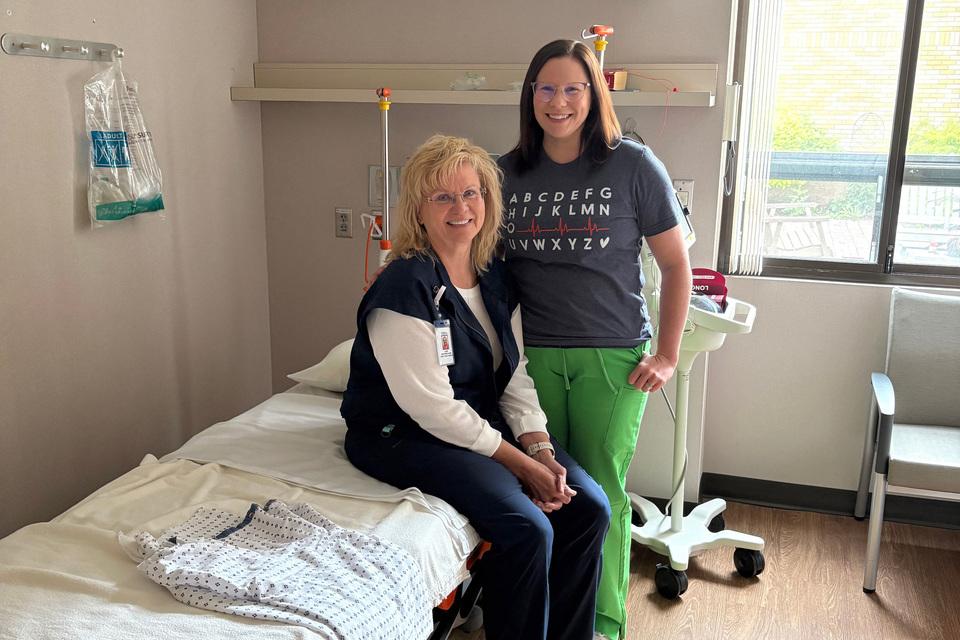
It isn’t uncommon to follow in your parents’ footsteps, whether by taking over the family business or pursuing a similar career. Altru Devils Lake has been fortunate to have multiple families working in our healthcare system throughout the years, including Lynn Dubois, RN, and her daughter, Farren Kurtz, RN. Their journey to working together as mother and daughter has included a few twists and turns along the way.
For Lynn and Farren, a commitment to caring for others spans generations. While their nursing careers began decades apart, both found their calling in healthcare and built meaningful careers serving patients in the Lake Region community.
Decades of Service in Devils Lake
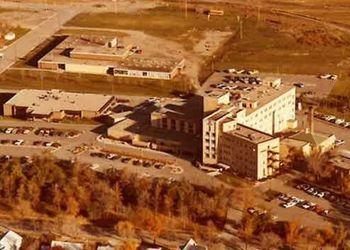
As a new nurse in 1990, Lynn Dubois began working at the hospital in Devils Lake. Not only were the times different, but so was the hospital. An entire wing of the building had not yet been built, and her young daughter, Farren, was able to watch the hospital evolve over the years, from additions to the building and changes in departments to her mom’s work in the emergency room (ER) and intensive care unit (ICU).
Farren would often sit in the waiting room or spend time with her mom after school while waiting to go home. She vividly remembers a Pac-Man video game in the waiting room where she spent many hours. Like many things from her childhood, she also remembers the emergency department looking much different than it does today.
“Our emergency room now highlights our staff and what they can provide to our region,” said Farren. “I remember looking at the telemetry monitors and having no clue what it meant.”
Those early experiences gave Farren a unique perspective on healthcare and the hospital where she would eventually begin her own career.
Adapting to Change in Healthcare
Throughout her career, Lynn has seen healthcare evolve dramatically.
When she first started as a nurse, the hospital used every floor and could accommodate up to 110 beds. The main floor of the hospital was often full, and surgeons were on site. In 2007, the hospital was designated as a critical access hospital, with a maximum of 25 beds available for inpatient care.
While the healthcare landscape has changed, Lynn and Farren share a similar perspective: adaptability is part of caring for a community.
For Lynn, watching her daughter pursue a nursing career felt like a natural progression.
“It’s always what she wanted to do,” said Lynn. “I never told her ‘Don’t become a nurse. You don’t want to work nights or holidays.’ It’s just been a long time coming. I know she’ll do great.”
A Commitment to Care
Farren’s path to becoming a nurse wasn’t always straightforward. Her career as a certified nursing assistant (CNA) in the ER began shortly after high school, but eventually she decided to take a break from healthcare.
“I did get burnt out working as a CNA,” said Farren. “I went and worked in education for six years as a paraprofessional. I was almost convinced to go to school for education, but panicked and said, ‘I need to go back to healthcare.’”
By winter break, she was working as needed as a CNA while still working in the school system. By summer, she had signed a contract to return to the ER full time.
The experience reaffirmed what she had known all along: helping patients and supporting her community was where she belonged.
A Nursing Career Built Through Apprenticeship
After returning to healthcare, Farren continued her education through the Lake Region State College apprenticeship program, earning her LPN license before recently completing her RN degree and passing her nursing boards.
The apprenticeship allowed her to gain hands-on experience while advancing her education, creating a clear path toward a nursing career.
Initially, her plan was to become a nurse in the ER because she enjoyed it so much as a CNA. As fate would have it, her plans changed.
Throughout Farren’s apprenticeship, she had the opportunity to work with many experienced nurses, including her own mom. During this time, Lynn gave her advice that helped shape Farren’s decision about which department she wanted to work in.
“When working on the medical-surgical floor, you use a lot of skills,” Lynn advised. “You have to know how to keep people moving forward and recognizing things before they become issues to get them well and out the door. You will learn a lot.”
Careers that Make a Difference
When asked if she planned to stay on the medical-surgical floor or return to the ER where her mom worked, Farren said she was enjoying the variety and complexity of the work.
“I think so. We see a variety of things that a lot of places don’t necessarily see on their medical floors with higher acuity patients, so I’m having the realization that, ‘Hey, I really like this.’”
For Lynn, watching her daughter begin a career at the same organization where she spent so much of her childhood feels especially meaningful.
“Watching her spend so much time here growing up and now starting her career here is pretty neat,” said Lynn.
Although Lynn now works in cardiac rehabilitation and Farren works on the medical-surgical floor, their connection to healthcare — and to Altru Devils Lake — remains strong.
For Farren, one part of the experience stands above the rest.
“Walking the same floors my mom walked is still one of the coolest things to come from this whole experience.”
Learn more about Altru’s apprenticeship program with Lake Region State College.