
Ankylosing spondylitis
Conditions
Overview
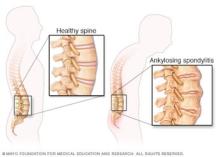
Ankylosing spondylitis, also called axial spondyloarthritis, is a type of inflammatory disease that mainly affects the spine. Over time, the inflammation can cause some of the bones in the spine, called vertebrae, to fuse together. This fusing makes the spine less flexible and can lead to a hunched posture. If the joints in the chest are affected, it may become harder to take deep breaths.
Axial spondyloarthritis has two types. When the condition is found on X-ray, it is called ankylosing spondylitis, also known as axial spondyloarthritis. When the condition cannot be seen on X-ray but is found based on symptoms, blood tests and other imaging tests, such as an MRI, it is called nonradiographic axial spondyloarthritis.
Symptoms often begin in early adulthood. The condition also can cause inflammation in other parts of the body. This happens most often in the eyes, called uveitis.
There is no cure for ankylosing spondylitis, but treatments can lessen symptoms, manage pain and possibly slow down the progression of the disease.
Symptoms
Early symptoms of ankylosing spondylitis might include back pain and stiffness, especially in the lower back and hips. These symptoms may be worse in the morning or after periods of inactivity. Neck pain and fatigue also are common. Other symptoms include vision changes or eye pain, skin rashes and stomach pain.
Symptoms can come and go over time. Some people have periods of increased pain and stiffness, followed by times when symptoms improve or go away for a while.
The most commonly affected areas are:
- The joints between the base of the spine and the pelvis, called sacroiliac joints.
- The vertebrae in the lower back.
- The places where tendons and ligaments attach to bones, mainly in the spine or along the back of the heel.
- The cartilage between the ribs and the breastbone.
- The hip and shoulder joints.
When to see a doctor
See a healthcare professional if you have low back or buttock pain that comes on slowly. Also see a healthcare professional if the pain feels worse in the morning or awakens you from your sleep at night, especially if this pain improves with exercise and worsens with rest. You also should seek care from an eye specialist right away if you develop a red, painful eye, light sensitivity or blurry vision since these can be signs of inflammation in the eye.
Causes
The exact cause of ankylosing spondylitis isn't known, but genetic factors seem to be involved. People who have a gene called HLA-B27 are at a greatly increased risk of developing ankylosing spondylitis. However, only some people with the gene develop the condition and not everyone with ankylosing spondylitis has this gene.
Risk factors
Risk factors for ankylosing spondylitis include:
- Younger age. The disease usually starts in late adolescence or early adulthood.
- Genetics. Most people who have ankylosing spondylitis have the HLA-B27 gene. But many people who have this gene never develop ankylosing spondylitis.
Complications
In serious cases of ankylosing spondylitis, the body tries to heal the long-term inflammation by forming new bone. Over time, this new bone bridges the gaps between vertebrae and causes them to fuse together. The fused parts of the spine become stiff and less flexible. If the joints in the chest around the rib cage also become stiff, the stiffness can limit how much the lungs can expand and make deep breathing more difficult.
Other possible complications include:
- Eye inflammation, called uveitis. Uveitis is one of the most common complications of ankylosing spondylitis. It can cause sudden eye pain, redness, light sensitivity and blurry vision. See your healthcare professional right away if you develop these symptoms.
- Compression fractures. When the bones in the spine weaken, they can press together and make a hunched posture worse. Vertebral fractures also can press on and possibly damage the spinal cord and nerves.
- Heart issues. Ankylosing spondylitis can cause issues with the aorta. The aorta is the largest artery in the body. When the aorta gets inflamed, it can swell and change the shape of the aortic valve in the heart. This makes the valve leak, and it can't work as well. This is called aortic regurgitation. This inflammation also increases the overall risk of heart disease.
Diagnosis
To diagnose ankylosing spondylitis, your healthcare professional may ask about your medical history, family history and symptoms. Your healthcare professional also may perform a physical exam to check your posture, flexibility, and areas of pain or stiffness. You also may be asked to take a deep breath to see if you have trouble expanding your chest.
Imaging tests
X-rays can check for changes in joints and bones, which can be a sign of ankylosing spondylitis, also called radiographic axial spondyloarthritis. Changes that appear on X-ray might take years to develop. Early disease might not show on X-ray images.
MRI uses radio waves and a strong magnetic field to provide more-detailed images of bones and soft tissues. MRI scans can detect nonradiographic axial spondyloarthritis earlier in the disease process. But MRI scans are much more expensive.
Lab tests
There are no specific lab tests to identify ankylosing spondylitis. Certain blood tests, including erythrocyte sedimentary rate, also called sed rate, and C-reactive protein (CRP), can check for markers of inflammation, but many different health issues can cause inflammation.
Blood can be tested for the HLA-B27 gene. But many people who have the gene don't have ankylosing spondylitis. And people who don't have the HLA-B27 gene can have the disease.
Treatment
The goal of treatment is to relieve pain and stiffness, maintain flexibility, and prevent or slow changes to the spine. Ankylosing spondylitis treatment works best when it's started early before permanent damage is done.
Medicines
Nonsteroidal anti-inflammatory drugs (NSAIDs) — such as naproxen sodium (Aleve) and ibuprofen (Advil, Motrin IB, others) — are the medicines healthcare professionals most commonly use to treat axial spondyloarthritis and nonradiographic axial spondyloarthritis. These medicines can relieve inflammation, pain and stiffness. They also irritate the stomach and may cause gastrointestinal bleeding.
If NSAIDs are not helpful, your healthcare professional might suggest starting a tumor necrosis factor (TNF) blocker or an interleukin-17 (IL-17) inhibitor. These medicines are injected under the skin or through an intravenous line. Another option is a Janus kinase (JAK) inhibitor. JAK inhibitors are taken by mouth. These types of medicines can reactivate untreated tuberculosis and make you more prone to infections.
Examples of TNF blockers include:
- Adalimumab (Humira).
- Certolizumab pegol (Cimzia).
- Etanercept (Enbrel).
- Golimumab (Simponi).
- Infliximab (Remicade).
IL-17 inhibitors used to treat ankylosing spondylitis include secukinumab (Cosentyx), ixekizumab (Taltz) and bimekizumab (Bimzelx). JAK inhibitors available to treat ankylosing spondylitis include tofacitinib (Xeljanz) and upadacitinib (Rinvoq).
Therapy
Physical therapy is a very important part of the treatment plan and can help relieve pain while improving flexibility, posture and strength. A physical therapist can design specific exercises for your needs. To help preserve good posture, you may be taught:
- Range-of-motion and stretching exercises.
- Strengthening exercises for abdominal and back muscles.
- Proper sleeping and walking positions.
Surgery
Most people with ankylosing spondylitis or nonradiographic axial spondyloarthritis do not need surgery. Surgery may be recommended if you have severe pain or if a hip joint is so damaged that it needs to be replaced.
Self care
Lifestyle choices also can help manage ankylosing spondylitis.
- Stay active. Exercise can help ease pain, maintain flexibility and improve your posture.
- Do not smoke. If you smoke, try to stop. Smoking is generally bad for your health and can make breathing even harder for people with ankylosing spondylitis.
- Practice good posture. Practice standing straight in front of a mirror. Standing straight can help you avoid some of the issues related to ankylosing spondylitis.
Coping and support
Living with ankylosing spondylitis can be challenging. The course of your condition can change over time, and you might have painful episodes and periods of less pain throughout your life. But most people can live productive lives despite a diagnosis of ankylosing spondylitis.
You might want to join an online or in-person support group of people with this condition, to share experiences and support.
Preparing for your appointment
You might first bring your symptoms to the attention of your healthcare team. Your primary health professional may refer you to a specialist in inflammatory disorders called a rheumatologist.
Here is some information to help you get ready for your appointment.
What you can do
Make a list of:
- Your symptoms, including any that may seem unrelated to the reason you made the appointment, and when they began.
- Key personal information, including major stresses, recent life changes and family medical history.
- All medicines, vitamins and other supplements you take and their doses.
- Questions to ask your healthcare professional.
Take a family member or friend along, if possible, to help you remember the information you are given.
For ankylosing spondylitis, basic questions to ask your healthcare team include:
- What is likely causing my symptoms?
- Other than the most likely cause, what are other possible causes for my symptoms?
- What tests do I need?
- Is my condition likely temporary or lifelong?
- What course of action do you recommend?
- What are the alternatives to the primary approach you are suggesting?
- I have other health conditions. How can I best manage them together?
- Are there restrictions I need to follow?
- Should I see a specialist?
- Are there brochures or other printed material I can have? What websites do you recommend?
What to expect from your doctor
Your healthcare professional is likely to ask you questions, such as:
- Where is your pain?
- How serious is your pain?
- Have your symptoms been continuous or occasional?
- What, if anything, seems to worsen or improve your symptoms?
- Have you taken medicines to relieve the pain? What helped most?
© 1998-2026 Mayo Foundation for Medical Education and Research(MFMER). All rights reserved. Terms of Use