
Baker cyst
Conditions
Overview
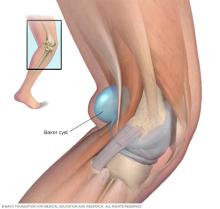
A Baker cyst is a fluid-filled growth behind the knee. It causes a bulge and a feeling of tightness. Also called a popliteal (pop-luh-TEE-ul) cyst, a Baker cyst can be painful. The pain can get worse with activity or when fully straightening or bending the knee.
A Baker cyst typically is caused by an issue with the knee joint, such as arthritis or a cartilage tear. Both conditions can cause the knee to produce too much synovial fluid. This fluid lubricates joints to reduce friction for pain-free motion. But the fluid can build up and move into a bursa, which is a small, fluid-filled sac that cushions the joint and reduces friction. In the case of a Baker cyst, the fluid collects behind the knee, causing it to swell and form a cyst.
While a Baker cyst may result in swelling and discomfort, treating the root cause — such as managing arthritis or repairing cartilage damage — typically leads to improvement.
Symptoms
Sometimes, a Baker cyst causes no symptoms. You may not notice it. If you do have symptoms, they may include:
- Swelling behind the knee, and sometimes in the leg.
- Knee pain.
- Stiffness that can make it hard to fully bend the knee.
These symptoms may worsen after you've been active or after you've been standing for a long time.
When to see a doctor
Seek medical care right away if you have pain and swelling behind your knee. Though it's rare, these symptoms may be a sign of a blood clot in a vein in the leg.
Causes
A lubricating fluid called synovial fluid lessens friction between the moving parts in the knee. It helps the leg swing smoothly. But some conditions may cause the knee to make too much synovial fluid. This excess fluid can build up in the back of the knee, forming a Baker cyst.
A baker cyst can be caused by:
- Inflammation of the knee joint, which typically is caused by certain types of arthritis, such as osteoarthritis or rheumatoid arthritis.
- A knee injury, such as a cartilage tear.
Complications
Rarely, a Baker cyst bursts and synovial fluid leaks into the calf region. This may cause:
- Sharp pain in the knee.
- Swelling in the calf.
- A change in skin color of the calf or a feeling of water running down the calf. The change in color may be a shade of red, purple or brown depending on your skin color.
Diagnosis
A Baker cyst often can be diagnosed during a physical exam. However, sometimes symptoms of a Baker cyst look like those of a blood clot, aneurysm or tumor. To get more information, your healthcare professional may order imaging tests such as:
- Ultrasound.
- X-ray.
- Magnetic resonance imaging, also called MRI.
Treatment
Sometimes a Baker cyst disappears on its own. Mild symptoms often can be managed by avoiding activities that trigger the symptoms.
However, if the cyst is large and causes pain, you may need treatment.
Medications
A pain reliever you can buy without a prescription, such as ibuprofen (Advil, Motrin IB, others), naproxen sodium (Aleve), acetaminophen (Tylenol, others) and aspirin, can reduce pain and inflammation.
An injection of steroid medicine, such as cortisone, into the knee may reduce inflammation. This may reduce the size of the cyst and relieve pain, but it doesn't always stop the cyst from coming back.
Therapies
Gentle exercises that increase range of motion and strengthen muscles around the knee may help improve movement and lessen discomfort.
Surgery or other procedures
To reduce the size of the cyst, your healthcare professional may drain the fluid from the cyst using a needle. This is called needle aspiration. It typically is guided by ultrasound. Sometimes an injection of steroid medicine, such as cortisone, is given following needle aspiration.
If a joint condition is causing the cyst, arthroscopic surgery may be needed to repair the issue. This type of surgery is a way for the healthcare team to see and fix issues inside a joint without making a big cut. For example, if a cartilage tear is causing synovial fluid to collect in the knee, the surgeon removes or repairs the torn cartilage. At the same time, the surgeon also may remove fluid from the cyst.
Surgery to remove the cyst rarely is needed. It's typically done if other treatments haven't worked and you're still having pain or trouble walking or doing everyday activities.
Lifestyle and home remedies
If arthritis is causing the cyst, your healthcare professional may recommend one or more of the following steps:
- Follow the R.I.C.E. method. These letters stand for rest, ice, compression and elevation. Rest your leg. Ice your knee. Compress your knee with a wrap, sleeve or brace. Elevate your leg when possible, especially at night.
- Take medicines you can buy without a prescription to manage pain. Medicines such as ibuprofen (Advil, Motrin IB, others), naproxen sodium (Aleve), acetaminophen (Tylenol, others) and aspirin can help relieve pain. Follow the dosing instructions on the package. Don't take more than the recommended dose.
- Reduce your physical activity. Doing so may help calm irritation in your knee joint. Ask your healthcare professional how long to limit activity. Ask about exercises that are easier on your knee in the meantime.
Preparing for an appointment
Here's some information to help you prepare for your appointment.
What you can do
- Write down any symptoms you have, even if they don't seem related to why you made the appointment.
- Note any major changes in your life recently.
- Make a list of all medicines, vitamins and supplements you take.
- Write down questions to ask your healthcare professional.
Your time with your healthcare professional may be limited. Having a list of questions ready can help you get the information you need. For a Baker cyst, you may want to ask questions such as:
- What caused this cyst to develop?
- What tests do I need? Do these tests require special preparation?
- Is a Baker cyst temporary or long lasting?
- What treatments are available, and which do you recommend?
- What side effects are likely from treatment?
- What steps can I take on my own that might help?
- Do I need to limit my activity? If so, how much and for how long?
- I have other health conditions. How can I best manage these conditions together?
Don't hesitate to ask other questions.
What to expect from your doctor
Your healthcare professional likely will ask you several questions, such as:
- When did your symptoms start?
- Do you feel pain or stiffness all the time, or only during certain activities?
- Does your knee swell, feel unstable or lock?
- How bad are your symptoms?
- Is there anything that makes your symptoms better?
- Is there anything that makes them worse?
© 1998-2026 Mayo Foundation for Medical Education and Research(MFMER). All rights reserved. Terms of Use