
Dysphagia
Conditions
Overview
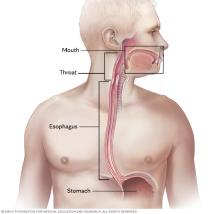
Dysphagia (dis-FAY-jee-uh) is the medical term for trouble swallowing. You may feel like you're having a hard time getting food sent on its way from the mouth and throat. Or you may feel like food gets stuck on the way down.
Trouble swallowing now and then, such as when you eat too fast or don't chew your food well enough, usually isn't cause for concern. Ongoing dysphagia needs treatment to prevent choking, poor nutrition and other serious complications.
Dysphagia can happen at any age, but it's more common in older adults. The causes of dysphagia vary, and treatment depends on the cause.
Symptoms
Symptoms of dysphagia can include:
- Needing increased effort to swallow food.
- Pain or discomfort with swallowing.
- Not being able to swallow.
- Feeling as if food is stuck in the throat or chest.
- Drooling or spilling food from the mouth.
- Food or stomach acid backing up into the throat or the nasal passage.
- Coughing or gagging when swallowing.
- Frequent heartburn.
- A hoarse voice.
- Weight loss that happens without trying.
When to see a doctor
See a healthcare professional if you often have trouble swallowing. Also, get medical care if weight loss, regurgitation or vomiting happens with your dysphagia.
If a blockage makes it hard to breathe, call for emergency help immediately. If you can't swallow because you feel that food is stuck in your throat or chest, go to the nearest emergency room.
Causes
Swallowing is a complex process involving the nerves and muscles of the mouth, throat and esophagus (uh-SOF-uh-gus).
During swallowing, the back of the roof of the mouth rises to prevent food in the throat from going up into the nasal passages. A flap in the throat prevents food from going into the airway to the lungs.
The esophagus is the muscular tube that connects the throat and stomach. A muscular ring at the top of the esophagus, called the upper esophageal sphincter, controls the flow of food from the throat to the esophagus. It prevents air from entering the stomach when you aren't eating and prevents contents of the esophagus from backing up into the throat.
The lower esophageal sphincter controls the flow of food from the esophagus to the stomach. It prevents the stomach contents from backing up into the esophagus.
In general, there are two causes of dysphagia:
- Damage to nerves or muscles limits the ability to swallow.
- A physical structure or object limits the passage of food.
There are two general types of dysphagia based on where the trouble with swallowing happens:
- Oropharyngeal (ohr-oh-fuh-RIN-jee-ul) dysphagia.
- Esophageal (uh-sof-uh-JEE-ul) dysphagia.
Oropharyngeal dysphagia
Oropharyngeal dysphagia is trouble with the beginning of swallowing — moving food from the mouth to the throat and into the esophagus. Conditions that cause oropharyngeal dysphagia include:
- Nervous system conditions. Conditions of the brain and nervous system — such as multiple sclerosis, muscular dystrophy and Parkinson's disease — affect the nerves and muscles that control swallowing.
- Nervous system damage. Sudden nervous system damage — such as a stroke or a brain or spinal cord injury — can affect the ability to swallow.
- Past treatments. Treatments for other conditions — such as chemotherapy, surgery or radiation treatment for cancer — may damage nerves or muscles used in swallowing.
- Cancer. Cancerous tumors of the mouth or throat may limit the passage of food.
- Zenker diverticulum. A small pouch of food particles in the throat, called a Zenker diverticulum, can develop and block food from entering the esophagus. It also causes gurgling sounds, bad breath, and repeated throat clearing or coughing.
Esophageal dysphagia
Esophageal dysphagia is trouble swallowing due to conditions in the esophagus. This type of dysphagia often results in the feeling of food sticking or getting caught in the base of the throat or in the chest.
In general, esophageal dysphagia is the result of conditions that narrow the esophagus or limit its ability to move food. Narrowing of the esophagus is called a stricture. Poor movement of food through the esophagus is called a motility disorder. A person may have more than one cause of esophageal dysphagia. These causes include:
- Nervous system conditions. Nervous system conditions, such as Parkinson's disease, or nervous system damage from stroke or trauma can result in poor muscle function in the esophagus.
- Achalasia. Achalasia (ak-uh-LAY-zhuh) is a nerve condition that affects the wave of muscle activity that moves food down the esophagus. Also, the lower esophageal sphincter does not open, stopping passage of food into the stomach. This condition gradually worsens over time.
- Esophageal spasm. With this condition, changes in contraction and relaxation of the esophagus muscles prevent food from moving through the esophagus and into the stomach.
- Gastroesophageal reflux disease (GERD). GERD is the frequent backflow of stomach acid into the esophagus. GERD-related damage to the esophagus causes scar tissue that narrows the passage and limits the movement of food.
- Cancerous tumors. Tumors progressively narrow the esophagus. Trouble swallowing food may worsen to difficulty swallowing liquids.
- Foreign bodies. Sometimes food or another object can partially block the throat or esophagus. Older adults with dentures and people who have difficulty chewing their food may be more likely to have a piece of food become stuck in the throat or esophagus.
- Esophageal ring. An esophageal ring is a ledge of tissue at the lower end of the esophagus that narrows the passageway. It also may be called an esophageal web. There may be multiple causes of this condition. An esophageal ring may sometimes slow the passage of food into the stomach.
- Eosinophilic esophagitis. Eosinophilic esophagitis (e-o-sin-o-FILL-ik uh-sof-uh-JIE-tis) is a disease of the immune system. An increase in white blood cells, called eosinophils, causes inflammation that narrows the esophagus.
- Radiation therapy. This cancer treatment can lead to inflammation and scarring of the esophagus that limits the passage of food.
Risk factors
The following are risk factors for dysphagia:
- Aging. Older adults are at higher risk of having trouble swallowing.
- Certain health conditions. People with certain nervous system conditions, such as stroke and Parkinson's disease, are more likely to have trouble swallowing.
- Cancer treatment. Radiation therapy or head and neck surgery increases the risk of dysphagia.
- Long-term care. The risk of dysphagia is high among people who live in nursing homes or have long hospital stays.
Complications
Trouble swallowing can lead to:
- Malnutrition, weight loss and dehydration. Dysphagia can make it difficult to take in enough food and fluids.
- Aspiration pneumonia. Dysphagia can result in food or water entering the lungs. Aspiration pneumonia is infection in the lungs when food or water introduces bacteria.
- Choking. Food stuck in the throat can cause choking. If food completely blocks the airway, death can occur if action to force out the blockage isn't taken right away.
Prevention
Although you can't prevent dysphagia, you can reduce your risk of sometimes having trouble swallowing by eating slowly and chewing your food well. However, if you have symptoms of dysphagia, see a healthcare professional.
If you have GERD, see a healthcare professional for treatment.
Diagnosis
Your healthcare professional asks you questions about your symptoms, medical history and recent treatments. You may be asked to fill out a questionnaire about your symptoms and their impact on daily life. Your health professional also conducts a thorough physical exam with particular attention to your head, neck, mouth and throat.
Diagnostic tests vary depending on whether symptoms suggest a condition in the throat or esophagus. Multiple specialists usually are involved in these tests. Tests may include:
- Clinical swallowing evaluation. A speech-language specialist does this test. The specialist observes swallowing behaviors while you swallow different types of foods and liquids. Symptoms, swallowing behaviors or other concerns that are reported may help guide additional testing.
- Barium swallow. A liquid barium solution can be seen on X-rays. A type of X-ray technology called videofluoroscopy shows the passage of the solution while you swallow. This test can show how well tissues function and whether there are tissue changes or blockages.
- Modified barium swallow. With this videofluoroscopy test, you swallow barium solutions of different thickness or different types of foods coated in barium. This shows a real-time evaluation similar to typical swallowing. It can reveal changes in structures and functions of the swallowing process. This test also is called a dynamic swallowing study.
- Endoscopy. This test uses an endoscope, a thin, flexible lighted instrument with a video camera. An endoscopy may be done through the nasal passage to observe the throat and upper sphincter of the esophagus. An endoscope also may pass through the mouth, into the throat and down the esophagus. Your healthcare team can see tissue changes or blockages. The team may use a tool with an endoscope to remove tiny tissue samples that can be studied in a lab. If there is a blockage, depending on the cause, your doctor may be able to remove it to improve swallowing.
- Fiber-optic endoscopic evaluation of swallowing (FEES). During a FEES study, an endoscope is passed through the nasal passage and into the throat. It is used to observe the throat during swallowing. Swallowing is monitored with different types of food and liquids.
- Esophageal muscle test, called manometry. In manometry (muh-NOM-uh-tree), a small tube is inserted into the esophagus and connected to a pressure recorder to measure the strength and timing of muscle contractions of the esophagus during swallowing.
- Imaging scans. These can include a CT scan or an MRI scan. A CT scan combines a series of X-ray views and computer processing to create cross-sectional images of the body's bones and soft tissues. An MRI scan uses a magnetic field and radio waves to create detailed images of organs and tissues.
- Nuclear medicine motility scan. This test uses a tracer added to foods to show how foods of various consistencies travel from the mouth to the stomach. This study is also called scintigraphy.
Treatment
The overall goals of treatment for dysphagia are to improve swallowing function that:
- Ensures good nutrition and hydration.
- Prevents airway blockage.
- Prevents entry of food or liquids into the lungs.
Treatment for dysphagia depends on the type of dysphagia or the underlying condition causing dysphagia. Treatments may include:
- Exercises. A specialist may teach you exercises to improve the strength and coordination of muscles for chewing, moving the tongue and swallowing.
- Swallowing techniques. You might learn ways to place food in your mouth or position your body and head to help you swallow.
- Changes to diet and eating habits. Your team may recommend a diet that includes a variety of textures or modified textures that are easier to swallow. You may be asked to alternate between solids and liquids and to eat at a slower pace.
- Esophageal dilation. Dilation involves placing an endoscope into the esophagus and inflating an attached balloon to stretch the esophagus. Also, a rigid tube may be passed through the mouth during the procedure to stretch the esophagus. This treatment is used for conditions that narrow the esophagus. A long, flexible tube, called a stent, may be placed in a dilated esophagus to help keep it open.
- Medicines. Difficulty swallowing caused by GERD can be treated with prescription medicines to reduce stomach acid. Corticosteroids and other medicines may be prescribed to treat inflammation of the esophagus. Muscle relaxants may help manage muscle spasms.
- Surgery. Surgery can be used to remove tumors, damaged tissues and other blockages. Other procedures are used to cut tissues of the lower esophagus or lower esophageal sphincter that limit the passage of food.
- OnabotulinumtoxinA (Botox). Shots of this medicine into the lower esophageal tissue may help relax muscles and provide short-term relief of dysphagia caused by the muscle activity of achalasia.
Severe dysphagia
A feeding tube may be recommended if difficulty swallowing prevents you from eating and drinking enough or if treatment doesn't allow you to swallow safely. A feeding tube provides nutrients without the need to swallow.
Severe dysphagia is a common condition during end-of-life care for people with conditions such as Alzheimer's disease, Parkinson's disease or other life-limiting illnesses. Careful consideration and conversation are recommended for the person with dysphagia, the family and caregivers, and the healthcare team. Based on the person's current or previously stated preferences, the decision to not use a feeding tube as part of care may be made to provide comfort and pain management at the end of life.
Lifestyle and home remedies
If you have trouble swallowing, be sure to see a healthcare professional. You also may try these approaches to help ease symptoms:
- Change your eating habits. Try eating smaller, more frequent meals. Cut your food into smaller pieces, chew food thoroughly and eat more slowly.
- Try different foods and drinks. Try foods with different textures to see whether some are harder or easier to swallow. Thickened liquids may be easier to swallow than thin liquids. Thickening products available in drug stores can be added to liquids that are difficult to swallow.
- Avoid sticky foods. Do not eat sticky foods that are difficult to swallow, such as peanut butter or caramel.
- Limit alcohol and caffeine. These can dry your mouth and throat, making swallowing more difficult.
Preparing for an appointment
See a healthcare professional if you're having trouble swallowing. Depending on the suspected cause, you may be referred to an ear, nose and throat specialist; a doctor who specializes in treating digestive disorders, called a gastroenterologist; or a doctor who specializes in diseases of the nervous system, called a neurologist.
Here's some information to help you prepare for your appointment.
What you can do
When you make the appointment, ask if there's anything you need to do in advance, such as restrict your diet.
Make a list of:
- Your symptoms, including any that don't seem related to trouble swallowing.
- Key personal information, including major stresses or recent life changes.
- All medicines, vitamins and supplements you take, the doses and the reasons for taking each one.
- Questions to ask your healthcare team.
For dysphagia, questions to ask include:
- What's the likeliest cause of my symptoms?
- What are other possible causes?
- What tests do I need?
- Is this condition temporary or long lasting?
- I have other health conditions. How can I best manage them together?
- Do I need to restrict my diet?
- Are there brochures or other printed material I can have? What websites do you recommend?
What to expect from your doctor
Your healthcare team is likely to ask you a number of questions, including:
- Do your symptoms come and go, or do you always have trouble swallowing?
- Are certain foods harder to swallow than others? Are you avoiding certain foods?
- Do you have difficulty swallowing solids, liquids or both?
- Do you cough or choke when you try to swallow?
- How much time do you take to eat a meal?
- Do you have trouble breathing or need to clear your throat often?
- Does it feel like food or pills get stuck?
- Do you bring food back up after swallowing it?
- Do you have frequent heartburn?
- Do you have GERD?
- Have you ever needed first aid for choking on food?
- Have you lost weight without trying?
What you can do in the meantime
Until your appointment, it might help to chew your food more slowly and thoroughly than usual. If you have heartburn or GERD, try eating smaller meals and not eating right before bedtime. Antacids that you can get without a prescription also might help for a short time.
© 1998-2026 Mayo Foundation for Medical Education and Research(MFMER). All rights reserved. Terms of Use