
Fibrocystic breasts
Conditions
Overview
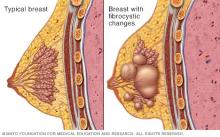
Fibrocystic breasts are a common condition that causes changes in breast tissue. Fibrocystic breasts are not cancer. The breast changes make breast tissue feel lumpy or like a rope in texture. Healthcare professionals call this nodular or glandular breast tissue.
Many women have fibrocystic breasts. Because this is so common and not an illness, healthcare professionals no longer call it a disease. Instead, they use the terms "fibrocystic breasts" or "fibrocystic breast changes." These changes often happen as part of the menstrual cycle. After a period, the breasts usually feel less lumpy.
Not everyone with fibrocystic breasts has symptoms. Some people feel breast pain or tenderness, which may feel aching or throbbing and last for a short time. The pain is often in the upper, outer part of the breast, where the lumpiness is felt. Symptoms are usually worse before a period and get better afterward. Simple self-care steps can often help ease the discomfort.
Symptoms
Signs and symptoms of fibrocystic breasts may include:
- Breast lumps or areas of thickening that blend into nearby breast tissue.
- Breast pain, tenderness or discomfort in the upper, outer part of the breast that often lasts for a few minutes to an hour. Pain may bother you most during the 5 to 7 days that you have your period.
- Green or dark brown nipple discharge that isn't bloody and that tends to leak without pressure or squeezing.
- Breast changes that are similar in both breasts.
- Breasts feel more lumpy from around the time you ovulate, halfway through the menstrual cycle, to just before your period starts. The lumpiness usually gets better after your period starts.
Fibrocystic breast changes occur most often between 30 and 50 years of age. These changes happen rarely after menopause unless you're using hormone medicine such as estrogen or progesterone.
When to see a doctor
Most fibrocystic breast changes are common and not a cause for concern. But make an appointment with your healthcare professional if:
- You find a new or persistent breast lump or area of breast tissue that suddenly feels very thick or firm and lasts over 2 to 3 menstrual cycles.
- You have specific areas of constant or worsening breast pain that goes on throughout your menstrual cycle.
- Your healthcare professional checked a breast lump, but now the lump seems to be bigger or otherwise different and doesn't go away. The lump may not be painful.
Causes
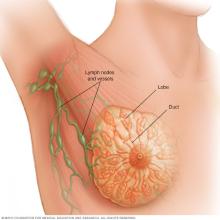
The exact cause of fibrocystic breast changes isn't known. Experts think that hormone changes, especially changes in estrogen during the menstrual cycle, may play a role.
Hormone changes during the menstrual cycle can cause breast discomfort and areas of breast tissue that feel lumpy, tender, sore or swollen. Fibrocystic breast changes often feel worse before a period and usually get better after the period starts.
When fibrocystic breast tissue is looked at under a microscope, it may show several types of changes, including:
- Small fluid-filled sacs, called cysts.
- Areas of thicker, scarlike fibrous tissue, also called fibrosis.
- Extra growth of cells that usually line the milk ducts or milk-producing areas of the breast, called breast lobules.
- Enlarged breast lobules, a change known as adenosis.
Risk factors
The risk of having fibrocystic breasts is highest among women between 30 and 50 years old. It's rare for people who have gone through menopause to have fibrocystic breast changes, unless they're on hormone therapy. Fibrocystic breast changes are common. Having fibrocystic breasts doesn't typically increase your risk of breast cancer.
Complications
Simple cysts and fibrosis don't raise your risk of breast cancer. However, certain changes such as hyperplasia, where too many cells grow at once, could very slightly raise your breast cancer risk. You may wish to talk with your healthcare professional about your breast changes and possible risks.
Diagnosis
Tests to evaluate your condition may include:
-
Clinical breast exam. Your healthcare professional feels, also called palpates, your breasts and the lymph nodes located in your lower neck and underarm area. Your healthcare professional does this to check for tissue growth, a firm mass or areas of thickening that are more noticeable in one breast compared with the other breast. If the breast exam and your medical history suggest you have typical breast changes, you may not need diagnostic imaging tests.
In some cases, you may need to come back after your period for another clinical breast exam. At that time, if the breast exam is concerning, you may need additional tests, such as a diagnostic mammogram or ultrasound.
- Mammogram. If there's a breast lump or area of thickened breast tissue found during the clinical breast exam, you may need a diagnostic mammogram. This is an X-ray exam that focuses on a specific area in your breast. It often requires more images of the breast that you may have during a routine screening mammogram. The radiologist closely examines the area of concern when reviewing the mammogram.
- Ultrasound. An ultrasound is a test that uses sound waves to produce images. An ultrasound of the breast is often performed along with a mammogram to look at an area of concern. If you're younger than age 30, you might have only an ultrasound and not a mammogram. Ultrasound is better for evaluating younger breasts because it does not emit radiation like a mammogram. Ultrasound also can show more clearly the differences between fluid-filled cysts and solid masses.
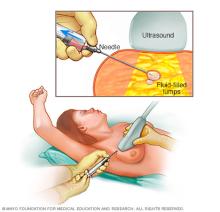
- Fine-needle aspiration. For a breast lump that feels like a cyst, your healthcare professional may try fine-needle aspiration to draw fluid from the lump. This procedure can be done in the office. A fine-needle aspiration may collapse the cyst and make pain or discomfort go away.
-
Breast biopsy. If a diagnostic mammogram and ultrasound do not show a clear problem, but your healthcare professional is still concerned about a breast lump, you may be referred to a breast surgeon. The surgeon reviews your imaging tests to see if you might need a biopsy.
A biopsy is a procedure to remove a sample of tissue for testing in a lab. To get the sample, a healthcare professional puts a needle through the skin and into the breast tissue. The health professional guides the needle using images created with X-rays, ultrasound or another type of imaging to locate the exact area to be tested.
Tell your healthcare professional if you notice any new breast changes or changes that do not go away. This is important even if a mammogram in the past year did not show anything concerning. To better understand the change, you may need a diagnostic mammogram or an ultrasound.
Treatment
If you don't have symptoms, or your symptoms are mild, no treatment is needed for fibrocystic breasts. You may want treatment if you have large, painful cysts or severe pain.
Treatment options for breast cysts include:
- Fine-needle aspiration. Your healthcare professional uses a hair-thin needle to drain the fluid from the cyst. Removing fluid confirms that the lump is a breast cyst and, in effect, collapses it, relieving your discomfort.
- Surgical removal. Rarely, surgery may be needed to remove a persistent cystlike lump that doesn't go away after repeated aspiration and careful monitoring or has features that concern your healthcare professional during a clinical exam.
Examples of treatment options for breast pain include:
- Pain relievers you can buy without a prescription, such as acetaminophen (Tylenol, others), or nonsteroidal anti-inflammatory drugs (NSAIDs), such as ibuprofen (Advil, Motrin IB, others), or prescription medication.
- Oral contraceptives, which lower the levels of cycle-related hormones linked to fibrocystic breast changes.
- Prescription medicines, such as danazol or tamoxifen, may help if you have severe breast pain.
Lifestyle and home remedies
You might find relief from symptoms of fibrocystic breasts by trying one or more of these strategies:
- Wear a supportive bra. A firm bra that fits well may help reduce breast discomfort. If possible, get fitted by a trained professional.
- Use a sports bra. Wearing a sports bra during exercise and while sleeping may help, especially when your breasts feel more sensitive.
- Limit or avoid caffeine. Some people say this helps their breast pain. But medical studies have not clearly shown that cutting back on caffeine reduces breast pain or other premenstrual symptoms.
- Eat less saturated fat. Saturated fat is found in foods such as high-fat meats, butter and some packaged baked goods. Eating less of these foods may help reduce breast pain or discomfort.
- Avoid smoking. Not smoking may help lower substances in the blood that can make breast pain worse.
- Use heat. A heating pad or warm water bottle may help ease discomfort.
- Think about changes to hormone therapy. If you take hormone therapy for menopause symptom relief, talk with your healthcare professional to see whether you still need the medicine. Stopping hormone therapy or using a lower dose could help with breast pain, but it also might make menopause symptoms such as hot flashes and vaginal dryness worse. Don't make any changes without talking to your healthcare professional first.
Alternative medicine
Some vitamins and dietary supplements may help ease breast pain for some people. Ask your healthcare professional if one of these options might work for you. You can also ask about safe doses and possible side effects. Options include:
- Evening primrose oil. This supplement may change the balance of fatty acids in your cells, which may lower breast pain.
- Flaxseed oil. Some small studies suggest that taking 1,000 milligrams (mg) of flaxseed oil twice a day may help lower breast pain.
-
Vitamin E. Early studies showed that vitamin E may help with breast pain that changes during the menstrual cycle. In one study, taking 200 international units (IU) twice a day for two months helped improve symptoms. Taking it longer did not show added benefit.
For adults, including people who are pregnant or breastfeeding, the maximum daily dose of vitamin E is 1,000 mg or 1,500 IU. Taking high doses of vitamin E may increase the risk of bleeding. Talk with your healthcare professional if you have concerns about bleeding or take medicines that affect bleeding.
If you try a supplement for breast pain, stop taking it if you don't notice any improvement after a few months. Try only one supplement at a time so you can tell whether it's helping.
Preparing for an appointment
You're likely to start by seeing your primary care doctor or other healthcare professional. Based on a clinical breast exam or findings on an imaging test, you may be referred to a breast health specialist.
The initial exam focuses on your medical history. Your healthcare professional will likely discuss your symptoms, their relation to your menstrual cycle and any other relevant information.
What you can do
To prepare for your appointment, make a list of:
- All your symptoms, even if they seem unrelated to the reason for your appointment.
- Key personal information, including the dates and results of any prior mammograms.
- All medicines, vitamins, herbs and supplements that you take.
- Questions to ask your healthcare professional during the appointment.
Basic questions to ask your healthcare professional include:
- What's causing my symptoms?
- Does my condition raise my risk of breast cancer?
- Do I need any tests?
- What treatment options do I have?
- What are the alternatives to the primary approach that you're suggesting?
- Are there any restrictions I need to follow?
- Are there any printed materials that I can have? What websites do you recommend?
Don't hesitate to ask questions anytime you don't understand something.
What to expect from your doctor
During the appointment, be prepared to answer questions such as:
- What are your symptoms and how long have you had them?
- Do you have any breast pain? If so, how bad is your pain?
- Do your symptoms occur in one or both breasts?
- When was your last mammogram?
- Have you ever had breast cancer or precancerous breast lesions?
- Has anyone in your family had cancer?
© 1998-2026 Mayo Foundation for Medical Education and Research(MFMER). All rights reserved. Terms of Use