
Gout
Conditions
Overview
Gout is a common form of arthritis that can affect anyone. It's known for sudden attacks of intense pain, swelling, redness and tenderness in one or more joints. The big toe is the joint most affected.
An attack of gout may happen suddenly, often in the middle of the night. The big toe might feel like it's burning. The affected joint is hot, swollen and so tender that the weight of the bedsheet on it may feel like too much pressure.
Gout symptoms may come and go. The redness may be harder to see on Black or brown skin. In people with long-term or poorly managed gout, a buildup of uric acid crystals may form firm, painless lumps under the skin. The lumps are called tophi (TOE-fie). But there are ways to manage symptoms and prevent attacks.
Symptoms
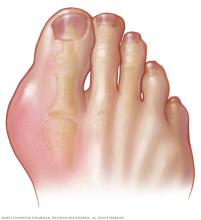
The symptoms of gout almost always happen suddenly, often at night. They include:
- Intense joint pain. Gout most often affects the big toe. But it can happen in any joint, including the ankles, knees, elbows, wrists and fingers. The pain is likely to be the worst within the first 8 to 12 hours after it starts.
- Discomfort that lasts. After the worst pain eases, some joint discomfort may last from a few days to a few weeks.
- Irritation, swelling and redness. The affected joint or joints become swollen, tender, warm and red. Redness may be harder to see on Black or brown skin.
- Limited range of motion. As gout goes on, moving the affected joints may be hard.
When to see a doctor
If you have sudden, intense pain in a joint, call your healthcare professional. Gout that isn't treated or that comes back can lead to worse pain and joint damage. Seek medical care right away if you have a fever and a joint is hot and inflamed. These symptoms may mean you have an infection.
Causes
The cause of gout is the buildup of uric acid in the blood. High levels of uric acid, also called hyperuricemia, can cause sharp uric acid crystals to form in the joints. This sets off an attack of pain and swelling. The body makes uric acid when it breaks down substances in the body called purines.
Purines also are in certain foods. These include red meat and organ meats, such as liver. Purine-rich seafood includes anchovies, sardines, mussels, scallops, trout and tuna. Alcoholic beverages, mainly beer, and drinks sweetened with a type of sugar called fructose can raise levels of uric acid.
Most often, uric acid passes through the kidneys into the urine. But sometimes either the body makes too much uric acid or the kidneys get rid of too little uric acid.
Risk factors
Having a high level of uric acid in the body raises the risk of gout. But some people who have high levels of uric acid never get a gout attack.
Factors that raise the uric acid level in the body include:
- Diet. Eating a diet rich in red meat and shellfish and drinking beverages sweetened with fructose raises levels of uric acid, in turn raising the risk of gout. Drinking alcohol, mainly beer, also raises the risk of gout.
- Weight. If you are overweight or have obesity, your body makes more uric acid. And your kidneys have a harder time getting rid of uric acid.
- Medical conditions. Certain conditions raise the risk of gout. These include high blood pressure that isn't treated and long-term conditions such as diabetes, obesity, metabolic syndrome, and heart and kidney diseases.
- Certain medicines. Low-dose aspirin and some medicines that manage high blood pressure can raise uric acid levels. These include thiazide diuretics, angiotensin-converting enzyme inhibitors, also called ACE inhibitors, and beta blockers. Other medicines that may raise uric acid levels are medicines to prevent organ rejection in people who have had an organ transplant.
- Family history of gout. If other members of your family have had gout, you're more likely to get the condition.
- Sex assigned at birth. People assigned male at birth are more likely than people assigned female at birth to have high uric acid levels. Once people go through menopause, their uric acid levels approach those of people assigned male at birth.
- Older age. People assigned male at birth are more likely to get gout from age 30 to 50. People assigned female at birth are more likely to get gout after age 60.
- Recent surgery or injury. Either of these can sometimes bring on a gout attack.
Complications
People with gout can get worse conditions, such as:
- Gout that comes back, called recurrent gout. Some people who get gout may never have gout symptoms again. Others may have gout several times each year. Medicines may help prevent gout attacks in people with recurrent gout. If not treated, gout can damage a joint.
- Advanced gout. Gout that isn't treated may cause urate crystals to form under the skin in lumps called tophi. Tophi can happen in several areas, such as the fingers, hands, feet, elbows or Achilles tendons, which are the tendons along the backs of the ankles. Tophi don't often hurt. But they can get swollen and tender during gout attacks.
- Kidney stones. Urate crystals may collect in the urinary tracts of people with gout, causing kidney stones. Medicines can help lower the risk of kidney stones.
Diagnosis
Healthcare professionals diagnose gout based on symptoms and how the affected joint looks. Tests to help diagnose gout may include:
- Joint fluid test. Your healthcare professional may use a needle to take fluid from your affected joint. Urate crystals may show in the fluid under a microscope.
- Blood test. Your healthcare professional may suggest a blood test to measure the levels of uric acid in your blood. But high levels of uric acid don't always mean gout. And some people who have symptoms of gout don't have high levels of uric acid during an attack.
- X-ray imaging. Joint X-rays can help rule out other causes of joint swelling and irritation. And certain features of gout that affect the joints show up on X-rays.
- Ultrasound. This test uses sound waves to find urate crystals in joint cartilage or in the lumps that may form under the skin, called tophi. Cartilage is the strong tissue that connects and protects the joints and bones.
- Dual-energy computerized tomography (DECT). This test uses X-ray images taken from different angles to show urate crystals in joints.
Treatment
Two types of medicines treat gout. One type helps lessen the swelling, irritation and pain of gout attacks. The other type works to prevent gout complications by lowering uric acid in the blood.
Which type of medicine is right for you depends on how often you get symptoms, how bad they are and other health conditions you have.
Medicines to treat gout attacks
Medicines that treat gout attacks and prevent new attacks include:
- Nonsteroidal anti-inflammatory drugs, also called NSAIDs. NSAIDs include medicines you get without a prescription such as ibuprofen (Advil, Motrin IB, others) and naproxen sodium (Aleve). They also include stronger prescription medicines such as indomethacin (Indocin) and celecoxib (Celebrex, Elyxyb). Too much NSAID use may cause stomach pain, bleeding and ulcers.
- Colchicine. Your healthcare professional may suggest colchicine (Colcrys, Gloperba, others), an anti-inflammatory medicine that lessens gout pain. Colchicine works best when taken within 24 hours of the start of symptoms. Side effects include upset stomach, vomiting and loose stools. Side effects may make it hard to take colchicine.
- Corticosteroids. Steroid medicines, such as prednisone, may control gout irritation, swelling and pain. You take steroids by mouth or get them as a shot into a joint. Side effects include mood changes, high blood sugar levels and high blood pressure.
- Anakinra (Kineret). Although this medicine isn't approved for treating gout, some healthcare professionals may suggest it for a few days to treat an attack. You take it as a daily shot. Side effects include an increased risk of infection. Other side effects are swelling, bruising and itching at the site of the shot.
Medicines to prevent gout complications
These medicines may be for people who have more than two gout attacks each year or for those who have fewer gout attacks that are very painful. Your healthcare professional may prescribe them if your X-rays show joint damage from gout or tophi or if you have a long-term kidney condition or kidney stones. You may need to take these medicines for life.
-
Medicines that block the making of uric acid. These include allopurinol (Aloprim, Lopurin, Zyloprim) and febuxostat (Uloric). You get allopurinol as a pill to take by mouth. Side effects of allopurinol include fever, rash, hepatitis and kidney issues.
Febuxostat also is a pill you take by mouth. Side effects include rash, upset stomach and liver issues. Febuxostat also may increase the risk of heart-related death.
-
Medicines that help rid the body of uric acid. Medicines such as probenecid (Probalan) help the kidneys remove uric acid from the body. You take probenecid as a pill by mouth. Side effects include rash, stomach pain and kidney stones.
Pegloticase (Krystexxa) given through a vein helps break down uric acid. Healthcare professionals use it for gout that is very bad or resists other treatment. Side effects include a serious allergic reaction called anaphylaxis, upset stomach, vomiting and trouble passing stool, called constipation.
Medicines that lower uric acid levels in the body can cause gout to recur, also called flare, when first taken. So treatment may include NSAIDs, colchicine or low-dose steroids to prevent flares.
Lifestyle and home remedies
These lifestyle choices are vital for people who have gout even if they take medicines:
- Drink healthier. Limit or don't drink alcohol, especially beer. That includes beer without alcohol. Limit or don't drink beverages sweetened with fructose. Limit fruit juice, which is high in fructose, as well. Drink plenty of water.
- Limit foods high in purines. These include red meat and organ meats, such as liver. Purine-rich seafood includes anchovies, sardines, mussels, scallops, trout and tuna.
- Exercise regularly and keep a healthy weight. Keeping your body at a healthy weight lowers your risk of gout. Low-impact activities such as walking, bicycling and swimming are easier on your joints.
Preparing for an appointment
Make an appointment with your healthcare professional if you have symptoms of gout. Your healthcare professional may send you to a specialist in joint, muscle and bone conditions, called a rheumatologist.
Here's some information to help you get ready for your appointment.
What you can do
Make a list of:
- Your symptoms, including when they started and how often they happen.
- Key medical information, including other conditions you have and any family history of gout.
- All medicines, vitamins and supplements you take, including dosages.
- Questions to ask your healthcare professional.
Take a family member or friend along, if possible, to help you remember all the information you get.
Questions to ask your healthcare professional include:
- What are the possible causes of my symptoms?
- What tests do I need?
- Are there treatments or lifestyle changes that might help my symptoms?
- Should I see a specialist?
Questions to ask a rheumatologist include:
- What are the possible side effects of the drugs you're prescribing?
- How soon after I start treatment should my symptoms improve?
- Do I need to take medicines long-term?
- I have other health conditions. How can I best manage them together?
- How should I change my diet?
- Is it safe for me to drink alcohol?
- Where can I find more information about this condition?
Be sure to ask all the questions you have.
What to expect from your doctor
Questions your healthcare professional may ask include:
- Do your symptoms come and go? How often?
- What seems to set off your symptoms, such as certain foods or stress?
- Have any of your parents, brothers or sisters had gout?
- What do you eat in a day?
- Do you drink alcohol? How much and how often?
© 1998-2026 Mayo Foundation for Medical Education and Research(MFMER). All rights reserved. Terms of Use