
Hamstring injury
Conditions
Overview
A hamstring injury involves straining or pulling one of the hamstring muscles — the group of three muscles that run along the back of the thigh. These muscles are attached to bones by tendons. The hamstring muscles start at the sitting bone at the lower back of your pelvis or the back of your thigh bone. They end at the shinbone on the lower leg.
Hamstring injuries often happen in people who play sports that involve sprinting with sudden stops and starts. Examples include soccer, basketball, football and tennis. Hamstring injuries also can occur in runners, especially sprinters, and in dancers.
Self-care measures such as rest, ice and pain medicine are often all that is needed to relieve the pain and swelling of a hamstring injury. Rarely, surgery is needed to repair a hamstring muscle or tendon.
Symptoms
A hamstring injury typically causes sudden, sharp pain in the back of the thigh. There also might be a "popping" or tearing sensation.
Swelling and tenderness usually develop within a few hours. There might be bruising or a change in skin color along the back of the leg. Some people have muscle weakness or are not able to put weight on the injured leg.
When to see a doctor
Mild hamstring strains can be treated at home. But see a healthcare professional if you can't bear weight on the injured leg or if you can't walk more than four steps without a lot of pain.
Causes
The hamstring muscles are a group of three muscles that run along the back of the thigh from the hip to just below the knee. The muscles are attached to the bone by tendons. The hamstring muscles make it possible to extend the leg back and to bend the knee. Stretching or overloading any one of these muscles beyond its limit can cause injury.
Risk factors
Hamstring injury risk factors include:
- Sports. Sports that require sprinting or running might make hamstring injury more likely. So might other activities that require extreme stretching, such as dancing.
- Earlier hamstring injury. People who have had one hamstring injury are more likely to have another one. This is especially true for people who try to go back to the same activities before the muscles have time to fully heal.
- Tired muscles, weak muscles and muscles that do not stretch well. Tired or weak muscles are more likely to be injured. Muscles with poor flexibility might not be able to bear the force of the action that certain activities require.
- Muscle imbalance. Muscle imbalance may lead to hamstring injury. If the muscles along the front of the thigh, called the quadriceps, are much stronger and more developed than the hamstring muscles, injury to the hamstring muscles might be more likely.
- Age. Risk of injury increases with age.
Complications
Returning to tiring activities before hamstring muscles are completely healed might cause the injury to happen again.
If the tendons attaching the muscles to the pelvis bone or the shin bone are completely torn off the bone, the hamstring muscles won't work as they should. Surgery may be needed to reattach the tendons.
Prevention
Being in good physical condition and doing regular stretching and strengthening exercises can lessen the risk of a hamstring injury. Try to be in shape to play your sport. Don't try to get in shape by playing your sport.
If you have a job that is physically demanding, staying in shape can help prevent injuries. Ask your healthcare professional about good exercises to do regularly to avoid injury.
Diagnosis
To diagnose a hamstring injury, a healthcare professional does a physical to check for swelling and tenderness along the back of the thigh. Where the pain is and how bad it is can give useful information about the damage.
Moving the injured leg into different positions helps pinpoint which muscle is hurt and whether there is damage to ligaments or tendons.
Imaging tests
In severe hamstring injuries, the muscle can tear, or the muscle tendon can separate from the pelvis or shinbone. When this happens, a small piece of bone can be pulled away from the main bone. This is known as an avulsion fracture. X-rays can check for avulsion fractures, while ultrasound and MRIs can show tears in the muscles and tendons.
Treatment
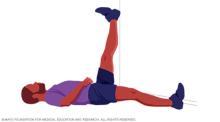
The first goal of treatment is to reduce pain and swelling. A healthcare professional might suggest the following:
- Take a break from strenuous activities to allow the injury to heal.
- Apply ice packs several times a day to relieve pain and reduce swelling.
- Wrap the injured area with a compression bandage or wear compression shorts to minimize swelling.
- Rest with the leg elevated above the level of the heart, if possible, to lessen swelling.
- Take pain medicine you can get without a prescription. Examples include ibuprofen (Advil, Motrin IB, others) and acetaminophen (Tylenol, others).
Physical therapy
Your healthcare professional or physical therapist can show you how to do gentle hamstring stretching and strengthening exercises. After the pain and swelling go down, your care team can show you how to do exercises to build more strength.
Surgery or other procedures
Most partial hamstring tears heal over time with physical therapy and do not require surgery. If the muscle tendons have pulled free from the pelvis or the shinbone, orthopedic surgeons can reattach them. Serious muscle tears also may need to be surgically repaired.
An emerging treatment option is platelet-rich plasma (PRP) therapy. This treatment involves taking a sample of your own blood and separating out the platelets and other healing factors. The solution of platelets and healing factors is then injected into the injured area. Researchers are still exploring the best way to use PRP, but it has shown promise in the treatment of muscle injuries.
Lifestyle and home remedies
To care for a minor hamstring injury yourself, try the R.I.C.E. approach:
- Rest. Take a break to rest your hamstring muscles and allow the damaged tissues to recover. Avoid any activity that causes pain, swelling or discomfort. If you have more than a minor muscle strain, your healthcare professional may recommend that you use crutches to keep weight off the injured leg.
- Ice. Ice the area as soon after the injury as you can. For the first few days after the injury, keep an ice pack on the injured area for 15 to 20 minutes every 2 to 3 hours while you are awake. Cold reduces pain and swelling. It also may slow bleeding if there is a tear. If you have vascular disease, diabetes or don't have much feeling in your leg, talk with your healthcare professional before icing.
- Compression. Wrap your leg with an elastic bandage until the swelling goes down. Be careful not to wrap too tightly. Begin wrapping at the end farthest from your heart. Loosen the bandage if the pain increases, the area becomes numb or swelling occurs below the wrapped area.
- Elevation. Sit or lie back with your leg raised while resting. If possible, raise your leg higher than your heart.
Pain medicine you can get without a prescription, such as ibuprofen (Advil, Motrin IB, others) and acetaminophen (Tylenol, others), also might help. After a few days, start using your injured leg gently. Over time, your leg should get better at supporting your weight and moving without pain.
Preparing for an appointment
You might first talk with your primary healthcare professional. You might be referred to an expert who practices sports medicine or does orthopedic surgery.
What you can do
Make a list that includes:
- Complete information about your symptoms and when they began.
- Information about medical issues you have had.
- All the medicines and supplements you take, including doses.
- Questions you want to ask the care team.
What to expect from your doctor
Your care team might ask some of the following questions:
- When did the injury occur and how did it happen?
- Did you feel a popping or tearing sensation?
- Do any movements or positions make the pain better or worse?
© 1998-2026 Mayo Foundation for Medical Education and Research(MFMER). All rights reserved. Terms of Use