
Intestinal obstruction
Conditions
By Mayo Clinic Staff
Overview
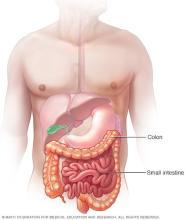
Intestinal obstruction is partial or complete blockage that keeps liquids or digested foods from passing through the small intestine or large intestine.
Common causes in adults include hernias, cancerous tumors and bands of scarlike tissues, called adhesions, that can squeeze hollow organs such as the intestines.
In young children, intestinal obstruction often happens when an intestine twists around itself or when one part of the intestine slips into an adjoining part of the intestine like a closed telescope.
Vomiting from intestinal obstruction can lead to severe loss of fluids and minerals. Without treatment, a loss of the blood supply to parts of the intestine can lead to serious and life-threatening complications. With prompt medical care, intestinal obstruction usually can be treated successfully.
Symptoms
Symptoms of intestinal obstruction may vary depending on whether the blockage is in the small or large intestine. Symptoms of obstruction of the small intestine often begin quickly. They may include:
- Crampy stomach pain that comes and goes and that may become constant.
- Vomiting.
- Upset stomach.
- Belly swelling.
- Loose stools early on when other symptoms begin.
- Constipation that gets worse.
- Inability to pass gas or stools.
With obstruction of the large intestine, also called the colon, symptoms often come on gradually and worsen over a few days. Symptoms may include:
- Constipation.
- Inability to pass gas or stools.
- Belly pain that is constant or comes and goes.
- Belly swelling.
- Vomiting that happens later than other symptoms.
In some cases, the primary symptom of obstruction of the large intestine is a gradual change in stool habits over weeks or months. An unintended loss of weight also may happen over this time.
When to see a doctor
Because of serious complications that can develop from intestinal obstruction, seek immediate medical care if you have severe belly pain or other symptoms of intestinal obstruction.
Causes
Common causes of intestinal obstruction in adults include the following:
- Intestinal adhesions are bands of scarlike tissue in the belly that can squeeze the intestines. Adhesions can form after surgery or disease in the belly or pelvic area.
- Hernias are bulges in the wall of the belly where internal organs such as the intestine push through muscles. If a part of the intestine becomes trapped in this bulge, the intestine can become blocked.
- Cancerous tumors in the intestines or elsewhere in the belly can cause blockages as the cancerous tissues grow.
- Volvulus is an obstruction caused by the twisting of the intestine around itself. This most often affects the large intestine.
- Inflammatory bowel diseases, such as Crohn's disease, damage the lining of the intestines. Tissue damage can create a narrowed passage or closure called a stricture.
- Diverticulitis is a condition in which small, bulging pouches form in the wall of the large intestine. Infection or inflammation of these pouches can obstruct the passage of waste.
- Impacted stool is dry, hard stool that is stuck in the rectum and prevents movement of waste through the intestines.
In children, common causes of intestinal obstruction include the following:
- Intussusception happens when one part of the intestine slips into a part next to it, like a closed telescope. This telescoping narrows or blocks the intestine.
- Volvulus is twisting of the intestine around itself. This condition blocks the passage of food or waste.
Pseudo-obstruction
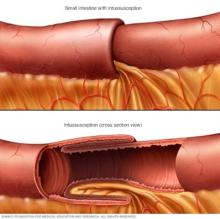
Pseudo-obstruction is a condition with the same signs, symptoms and certain imaging findings of intestinal obstruction. Food and liquids cannot move through the intestines, but there is no physical structure that would cause the blockage. Pseudo-obstructions are caused by:
- Belly or pelvic surgery.
- Infection.
- Certain medicines that affect muscles and nerves, including antidepressants and opioids.
- Muscle and nerve conditions, such as Parkinson's disease.
Pseudo-obstructions from surgery may be self-correcting, but treatment is generally required when there are other causes.
Risk factors
Factors that can increase the risk of intestinal obstruction include:
- Belly or pelvic surgery.
- Crohn's disease or other long-term disease of the intestines.
- Cancer in your belly.
Complications
If not treated, intestinal obstruction can cause serious, life-threatening complications, including:
- Dehydration. Intestinal obstruction prevents your intestines from absorbing nutrients and fluids. If this happens, the body doesn't have enough fluid and essential minerals to function.
- Tissue death. Intestinal obstruction can cut off the blood supply to part of your intestine. Lack of blood causes the intestinal wall to die.
- Perforation. This is a break in the wall of the intestine caused by tissue death or pressure that enlarges part of the intestine.
- Infection. A break in the wall of the intestine can cause infection in the lining of the belly. This life-threatening infection, called peritonitis, requires immediate treatment.
Diagnosis
A review of symptoms and a physical exam can often show that intestinal obstruction is the likely condition. The exam may include:
- Listening for sounds in the digestive tract with a stethoscope.
- Checking for signs of dehydration such as rapid heart rate or low blood pressure.
- Pressing on the belly and groin.
- Examining the rectum with a gloved finger.
Blood tests
Laboratory tests of blood can check for signs of dehydration, rule out other causes and look for signs of immune system activity.
Imaging
Imaging tests are done to confirm a diagnosis, locate the site of the blockage and find the cause. Some treatments may be started before you finish diagnostic imaging tests. The imaging tests may include:
- X-ray. X-rays are taken while standing and lying down. These images may be enough to confirm a diagnosis and find the cause and location of the obstruction.
- Computerized tomography (CT). A CT scan combines a series of X-ray images taken from different angles to produce cross-sectional images. These images are more detailed and may show obstructions more clearly than a standard X-ray. A liquid called a contrast agent can make images clearer. A procedure called an enema may be done to inject the liquid into the intestines through the anus.
- Ultrasound. Ultrasound also may be used, especially with children. An ultrasound can show intussusception, which is the most common cause of intestinal obstruction in children. It also may be used for people who cannot undergo other imaging tests.
Treatment
Treatment for intestinal obstruction depends on the cause of your condition, but it generally requires hospitalization. Treatment may be started before all diagnostic tests are completed.
Treatment to manage symptoms and complications
In the hospital, your healthcare team begins treatments to lessen symptoms and prevent complications of intestinal obstruction. These treatments include:
- Giving you fluids through a tube placed in a vein, called an IV line.
- Putting a tube through your nose and into your stomach to suck out contents and air to relieve pressure on your digestive tract.
- Placing a thin, flexible tube, called a catheter, into your bladder to drain urine to keep track of fluid levels and test for certain complications.
Surgery
Surgery generally is needed if diagnostic tests show signs of:
- Tissue death or risk of tissue death.
- Tumors.
- Twisted intestines.
- Adhesions.
- A hernia that entraps part of an intestine.
The goals of surgery are to remove whatever is causing the obstruction, if possible, and remove any part of the intestine that is damaged.
Treatment without surgery
Treatments that don't require surgery include the following:
Stent. In some cases, a procedure may be done to place a stent in the blocked part of the intestine. The stent is a hollow tube that can hold the intestine open. This is most commonly used for an obstruction in the large intestine.
This procedure is done with a tube, called an endoscope, that guides the stent through the anus and to the obstructed area. This is usually a temporary solution to allow time for other treatments, such as cancer treatments or nonemergency surgery.
- Contrast agent. There is some evidence that the contrast agent used to improve CT imaging also may help correct an intestinal obstruction.
Diet. For some people, ongoing or recurring intestinal obstruction may be managed with changes in diet. This may be recommended if blockage isn't complete and there's no sign of tissue loss or rupture.
The diet reduces foods that are not digested well or that pass through the intestines without being broken down. Foods to avoid include high-fiber grains and vegetables, seeds, and nuts.
Treatment for intussusception
If there are no signs of complication, intussusception is treated with an air or saline solution enema. This procedure forces air or a liquid solution through a tube placed in the rectum. The pressure from the air or saline enema causes the telescoped part of the intestine to open.
If there are signs of a tear in the wall or infection, surgery is necessary to remove damaged tissue.
Treatment for pseudo-obstruction
Treatment of pseudo-obstruction is supportive care in the hospital. Fluids are given through an IV to prevent dehydration. Nutritional fluids may be given through an IV or tube that goes through the nose and into the stomach.
If the underlying cause is known, it is treated if possible. If a medicine is likely causing pseudo-obstruction, you are taken off the medicine. You also may be prescribed medicine that causes muscle contractions. This can help move food and fluids through your intestines.
If the condition doesn't get better or the large intestine becomes too big, a treatment called decompression may provide relief. This procedure removes gas or waste from the large intestine.
Decompression can be done with a colonoscopy. For a colonoscopy, a thin tube is placed into the anus and guided into the colon. Decompression also can be done through surgery.
Preparing for your appointment
Intestinal obstruction is usually a medical emergency. As a result, you may not have much time to prepare for an appointment. If you have time before your appointment, make a list of your symptoms so that you can better answer your healthcare professional's questions.
What you can do
Be prepared to answer questions about:
- Your symptoms, including any that may not be related to your belly pain or related symptoms.
- Key personal information, including any recent stressors, major life changes, and family and personal medical history. Include recent infections and other conditions you have.
- All medicines, vitamins and other supplements you take, as well as the doses and the reason for taking each one.
What to expect from your doctor
Your healthcare professional is likely to ask you a few questions, including:
- When did you begin experiencing pain or other symptoms?
- How would you rate your pain on a scale of 1 to 10?
- Is your pain continuous?
- Did your symptoms come on quickly?
- Have you had symptoms like these before?
- Have you experienced nausea, vomiting, fever, blood in your stool, diarrhea or constipation?
- Have you had surgery or radiation of the belly?
© 1998-2026 Mayo Foundation for Medical Education and Research(MFMER). All rights reserved. Terms of Use