
Monomorphic ventricular tachycardia
Conditions
Overview
Monomorphic ventricular tachycardia (VT) is a type of irregular heartbeat, called an arrhythmia. It starts in the lower chambers of the heart, called the ventricles. In this condition, the heart usually beats more than 100 times a minute. The heart may beat so fast that it can't pump enough blood to the body.
Monomorphic VT is a type of ventricular tachycardia. It also may be called monomorphic V-tach.
The term "monomorphic" means each heartbeat looks about the same on a heart test called an electrocardiogram (ECG or EKG). In monomorphic VT, the lower heart chambers beat very fast, but the heartbeat signals still follow an organized pattern.
Monomorphic VT can be serious. The fast heartbeat may cause symptoms such as chest pain and shortness of breath. Sometimes, monomorphic VT can cause a life-threatening fast heartbeat called ventricular fibrillation (VFib). VFib can lead to sudden cardiac arrest.
Damage or scarring of the heart muscle from a heart attack is a common cause of monomorphic VT. A disease of the heart muscle called cardiomyopathy also may cause it. But sometimes monomorphic VT happens in people who do not have changes to the heart structure that can happen after a heart attack or with cardiomyopathy.
Treatment can stop an episode of monomorphic VT and help prevent future episodes. Treatment depends on how long the fast heartbeat lasts, how it affects blood flow and whether there's underlying heart disease.
Types
Monomorphic ventricular tachycardia (VT) is a type of irregular heartbeat, called an arrhythmia, that affects the lower heart chambers. It can be grouped by how long an episode of the fast heartbeat lasts:
- Nonsustained monomorphic ventricular tachycardia lasts less than 30 seconds and stops on its own. Brief episodes might not cause any symptoms.
- Sustained monomorphic ventricular tachycardia lasts 30 seconds or longer. An episode that lasts less than 30 seconds also is considered sustained if it needs to be stopped because it's causing serious problems with blood flow. Sustained monomorphic VT can be life-threatening and may need treatment right away.
Many other types of irregular heartbeats can affect the heart's lower chambers and its ability to pump blood to the rest of the body. Some types that may be confused with monomorphic VT are:
- Polymorphic ventricular tachycardia (VT). The lower heart chambers beat very fast. But unlike monomorphic VT, the shape of the heartbeats looks different from beat to beat on an ECG test.
- Ventricular fibrillation (VFib). The lower heart chambers contract in a very fast and uncoordinated way. VFib needs emergency treatment to prevent sudden cardiac death.
Symptoms
Monomorphic ventricular tachycardia (VT) may not always cause symptoms, especially when an episode of the fast heartbeat is short. When symptoms occur, they can vary based on the speed of the heartbeat, how long the episode lasts and whether you have other heart conditions.
Symptoms of monomorphic VT may include:
- Pounding heartbeat, called palpitations.
- Shortness of breath.
- Chest pain or discomfort.
- Dizziness or lightheadedness.
- Fainting or feeling faint.
- Feeling generally unwell.
When to seek care
Talk with a healthcare professional if you have a fast or pounding heartbeat, dizziness or lightheadedness. Testing may be needed to find out whether a heart rhythm disorder is causing your symptoms.
If you have been diagnosed with monomorphic ventricular tachycardia, follow your healthcare team's instructions about what to do when symptoms occur. Contact your care team if symptoms change, happen more often or get worse.
When to seek emergency care
Monomorphic ventricular tachycardia (VT) can keep the heart from pumping enough blood to the brain and other organs. Some episodes can lead to cardiac arrest.
Call 911 or your local emergency number if you have a fast heartbeat along with any of these symptoms:
- Chest pain or discomfort.
- Severe shortness of breath.
- Fainting or feeling faint.
- Confusion or another sudden change in awareness.
Causes
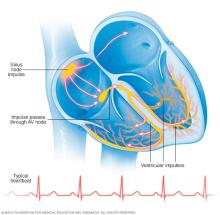
Monomorphic ventricular tachycardia (VT) happens when faulty electrical signals in the lower heart chambers cause the heart to beat too fast. The two lower chambers of the heart are called the ventricles. Most often, monomorphic VT is linked to heart disease that has damaged or scarred the heart muscle. The scar can create a pathway that allows the signals that make the heart beat to travel in a loop. This can repeatedly trigger fast heartbeats.
Heart conditions that can cause monomorphic ventricular tachycardia include:
- Coronary artery disease and a previous heart attack. A heart attack can leave scar tissue in the heart muscle. This is a common cause of monomorphic VT.
- Cardiomyopathy. Diseases that change or damage the heart muscle, grouped in a category called cardiomyopathy, can lead to monomorphic VT.
- Other structural heart conditions. Monomorphic VT also can occur in people with congenital heart disease, heart valve disease, cardiac sarcoidosis and other conditions that affect the heart's structure.
Sometimes monomorphic VT occurs in people who don't have structural heart disease. When this happens, it's called idiopathic ventricular tachycardia.
How does the heart beat?
To better understand the cause of monomorphic ventricular tachycardia, it may help to know how the heart works.
The typical heart has four chambers.
- The two upper chambers are called the atria.
- The two lower chambers are called the ventricles.
The heart's electrical system controls the heartbeat. The heart's electrical signals start in a group of cells at the top of the heart called the sinus node. The signals travel through the upper heart chambers to another group of cells called the atrioventricular (AV) node. From there, the signals travel to the ventricles, causing them to squeeze and pump blood.
In a healthy heart, this heart signaling process usually goes smoothly, resulting in a resting heart rate of 60 to 100 beats per minute.
But some things can change how electrical signals travel through the heart. In monomorphic VT, faulty electrical signaling in the heart's lower chambers makes the heart beat more than 100 times a minute.
Risk factors
The risk of monomorphic ventricular tachycardia (VT) is higher in people who have:
- A history of a heart attack.
- A heart muscle disease called cardiomyopathy.
Other things may trigger an episode of monomorphic VT in someone who is already at risk. These include:
- Low levels of certain minerals in the blood, called electrolytes. These include potassium and magnesium.
- Some medicines that affect the heartbeat.
- Stimulant drugs such as cocaine or methamphetamine.
Complications
Monomorphic ventricular tachycardia (VT) can keep the heart from pumping enough blood to the body. If blood flow drops too much, the condition can be life-threatening.
Possible complications of monomorphic VT may include:
- Heart failure. Monomorphic VT can make heart failure worse in people who have it.
- Ventricular fibrillation. Monomorphic VT can lead to ventricular fibrillation (VFib). This dangerous heart rhythm needs treatment right away.
Diagnosis
To diagnose monomorphic ventricular tachycardia (VT), a healthcare professional examines you and listens to your heart.
You also have tests to check your heartbeat and look for causes of monomorphic VT.
Electrocardiogram
An electrocardiogram (ECG or EKG) is the main test used to diagnose monomorphic ventricular tachycardia (VT). Your healthcare professional often does it in the exam room.
The test records the heart's electrical activity. It shows how the heart is beating.
If possible, a healthcare professional does the test while you have a fast heartbeat. If you've had an ECG before, your healthcare professional may compare the results from the two tests to look for changes.
The ECG can show patterns that help your healthcare professional tell if:
- Heartbeat changes start in the lower heart chambers.
- Heartbeats have the pattern seen with monomorphic VT.
On an ECG, monomorphic VT often looks like a very fast heartbeat that follows a steady pattern. The ECG shows the heartbeat as lines on a screen or paper. Parts of these lines, called QRS complexes, have the same general shape from beat to beat. In monomorphic VT, the QRS complexes are wider than usual. Their shape can help your healthcare professional tell where the fast heartbeat starts.
Some other fast heartbeats can look like monomorphic VT on an ECG. This includes some types of supraventricular tachycardia. In supraventricular tachycardia (SVT), fast or erratic heartbeats affect the heart's upper chambers. Electrical signals travel through the heart in a way that's not usual.
When a diagnosis of monomorphic VT isn't clear from the ECG, your healthcare professional looks at your medical history and other test results to help with a diagnosis.
Heart monitors
If monomorphic VT is suspected but isn't found during an ECG, a heart monitor may help record the heart's electrical activity during an episode. The heart monitor used may depend on how often symptoms happen.
Heart monitoring may include:
- Hospital heart monitoring. If you're in the hospital after an episode of very fast heartbeats, your heart rhythm may be watched continuously. This can help your care team find more episodes and look for things that may trigger them.
- Portable heart monitor. If symptoms come and go, you may wear a portable heart monitor for a longer period of time. An event monitor or another type of extended heart monitor may record the fast heartbeats when they happen. An event monitor is a small, wearable device. It's typically worn for about 30 days. You usually push a button when you feel symptoms. Some devices automatically record when an irregular heart rhythm is noticed.
- Implantable heart monitor. If symptoms happen rarely, a small heart monitor placed under the skin of the chest may be used to record the heart rhythm for longer periods of time. This type of device is called an implantable loop recorder. It might be used when a suspected irregular heartbeat hasn't been captured with other monitoring.
Tests to learn the cause
After monomorphic VT is diagnosed, tests may be done to look for heart disease or other conditions that may be causing the condition. Tests may include:
- Echocardiogram. This test uses sound waves to create pictures of the heart. It can show the heart's structure and how well it pumps blood.
- Cardiac MRI. This test creates detailed pictures of the heart and can help find damaged or scarred heart muscle. It also can help identify some types of cardiomyopathy and other structural heart conditions.
- Blood tests. Blood tests may be done to check electrolyte levels and look for other things that may cause irregular heartbeats.
- Stress test. This test shows how the heart works during physical activity. If you can't exercise, you may be given medicine that affects the heart like exercise does. A stress test may be used to look for reduced blood flow to the heart caused by coronary artery disease.
- EP study. During an electrophysiology (EP) study, healthcare professionals use thin, flexible tubes called catheters to record electrical signals inside the heart. The test may help confirm the diagnosis. It also may find where the irregular heartbeats start or help guide treatment.
- Coronary angiogram. This X-ray test looks at the heart's blood vessels. It checks for any that are narrowed or blocked.
- Genetic testing. Some heart conditions that are linked to monomorphic VT are passed down in families. These include some types of cardiomyopathy. Your healthcare professional may recommend genetic testing if a condition that runs in families could be causing your monomorphic VT. You also may meet with a genetic counselor to learn more about the testing and what the results could mean.
Treatment
Treatment for monomorphic ventricular tachycardia (VT) depends on what's happening during the fast heartbeat. Your healthcare team checks your pulse and does tests to see how much blood is being pumped from the heart. Treatment can stop an episode, help prevent future episodes and lower the risk of life-threatening complications.
Emergency treatment
Monomorphic VT may be treated with electrical shocks to the heart, depending on whether there's a pulse or how blood is flowing. If monomorphic VT causes cardiac arrest and there is no pulse, it is called a shockable rhythm.
- If there is a pulse and the person is not stable, a treatment called synchronized cardioversion may be done. This treatment delivers low-energy shocks to the heart that are timed with the heartbeat to help restore a regular heart rhythm.
- If there is no pulse, monomorphic VT is treated as sudden cardiac arrest. That means a person gets immediate cardiopulmonary resuscitation (CPR) and defibrillation, which sends an electrical shock to the heart. Medicines also may be given during CPR.
Medicines
Medicines that control the heartbeat, called antiarrhythmics, may be used to stop monomorphic VT or keep it from coming back. The medicine used depends on your heart condition and other health needs.
For example, beta blockers help slow the heart rate. They also may help prevent some types of monomorphic VT from coming back.
Medicines for monomorphic VT may cause side effects or other heartbeat changes. Your healthcare team considers the benefits and risks when choosing the right medicine for you.
Surgery or other procedures
Procedures for monomorphic VT may include:
- Implantable cardioverter-defibrillator (ICD). This small, battery-powered device is placed in the chest. It detects and stops irregular heartbeats. An ICD constantly checks the heartbeat. It delivers electric shocks, when needed, to restore a regular heartbeat. An ICD may be recommended for people who have sustained monomorphic VT and structural heart disease. It can lower the risk of sudden cardiac death.
- Ventricular tachycardia ablation. This type of ablation procedure may be recommended for monomorphic VT that keeps coming back. It also may be used if VT causes an ICD device to send shocks to the heart repeatedly or when medicines don't work or can't be used. Some types of monomorphic VT that occur without structural heart disease can be treated successfully with catheter ablation.
During this procedure, a healthcare professional guides one or more thin, flexible tubes called catheters through blood vessels to the heart. Sensors on the tips of the catheters use energy to create tiny scars in areas of the heart where the changed heartbeats pass through. The scars can block the electrical signals that cause monomorphic VT.
Other treatments
Treatment also may include managing health conditions that can cause or lead to monomorphic VT. For example, your healthcare team may treat low potassium levels, reduced blood flow to the heart muscle, called myocardial ischemia, or other underlying heart conditions.
Prognosis
The outlook, also called the prognosis, for people with monomorphic ventricular tachycardia (VT) varies. It depends in large part on the type of monomorphic VT and whether you have heart disease.
Monomorphic VT linked to structural heart disease can come back after treatment. It also can increase the risk of life-threatening heartbeats and sudden cardiac death. Treatments such as an ICD, medicines and catheter ablation may be used to lower these risks or reduce how often monomorphic VT occurs.
The outlook generally is better for people who have idiopathic monomorphic VT, which occurs without apparent structural heart disease. Sudden cardiac death is not common with idiopathic monomorphic VT, although it can happen. Many types of idiopathic monomorphic VT can be successfully treated with catheter ablation.
Coping and support
Living with monomorphic ventricular tachycardia (VT) may cause stress or worry. You may worry about having another episode. If you have an ICD, you also may worry about getting a shock. An ICD shock can be painful, but the shock may be needed to stop a dangerous heart rhythm.
Learning about your condition and knowing what to do if symptoms return may help you feel more prepared. Talk with your healthcare team about:
- What symptoms to watch for and when to seek emergency care.
- What activities are safe for you.
- What to expect if you have an ICD.
- Your treatment options if episodes of monomorphic VT keep happening.
If changes in your heartbeat cause worry, tell your healthcare team. You may benefit from additional support.
Preparing for an appointment
Heart conditions often are treated by doctors trained in heart diseases. This type of healthcare professional is called a cardiologist.
If you have monomorphic ventricular tachycardia, you may not have time to prepare for an appointment. You may be treated at a hospital or emergency medical center.
If possible, bring someone with you who can provide support and help you remember information you're given. There may be a lot to discuss, so it helps to collect details about your condition if you can.
Make a list of:
- Your symptoms, including any that may seem unrelated to your heart.
- Important personal information, including any major stresses or recent life changes.
- Medicines that you take, including vitamins, supplements and those bought without a prescription. Include the doses.
- Questions to ask your healthcare team.
Basic questions you may want to ask include:
- What is likely causing my fast heart rate?
- What tests do I need?
- How do we check my heart?
- What's the most appropriate treatment?
- What are the risks and complications of monomorphic ventricular tachycardia?
- How often do I need health checkups?
- I have other health conditions. How do I manage them together?
- Do I need to change my activities?
- Is there any printed information that I can take home with me? What websites do you recommend?
Don't hesitate to ask any other questions that you have.
What to expect from your doctor
When your heartbeat is controlled, your healthcare team is likely to ask you several questions. Your care team may ask:
- When did the symptoms start?
- How often do you have episodes of a fast heartbeat?
- How long do the episodes last?
- Does anything, such as exercise, stress or caffeine, seem to trigger or worsen episodes?
- Does anyone in your family have heart disease or a history of irregular heartbeats, called arrhythmias?
- Has anyone in your family died suddenly or died without a known cause?
- Do you smoke?
- How much alcohol or caffeine do you use?
- Do you use substances such as cocaine or methamphetamines?
- Do you have high blood pressure, high cholesterol, or other heart or blood vessel conditions?
- What medicines do you take for these conditions, and do you take them as prescribed?
© 1998-2026 Mayo Foundation for Medical Education and Research(MFMER). All rights reserved. Terms of Use