
Obstructive sleep apnea
Conditions
Overview
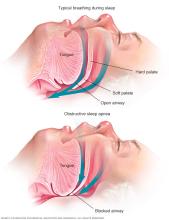
Obstructive sleep apnea is the most common sleep-related breathing disorder. People with obstructive sleep apnea repeatedly stop and start breathing while they sleep. These breath pauses are known as apneas.
There are several types of sleep apnea. Obstructive sleep apnea occurs when the throat muscles relax and block the airway. This happens off and on many times during sleep. A common sign of obstructive sleep apnea is snoring.
Treatments for obstructive sleep apnea are available. One treatment is a device that uses air pressure to keep the airway open during sleep. Another option is a mouthpiece to thrust the lower jaw forward during sleep. In some people, surgery might be an option. In people with obesity, weight loss may improve symptoms of obstructive sleep apnea.
Symptoms
Symptoms of obstructive sleep apnea during the night include:
- Loud snoring.
- Pauses in breathing during sleep, often noticed by a partner.
- Waking during the night gasping or choking.
- Needing to urinate often.
Symptoms of obstructive sleep apnea during the day include:
- Excessive daytime sleepiness.
- Waking in the morning with a dry mouth or sore throat.
- Morning headaches.
- Trouble focusing.
- Mood changes, such as feeling depressed or being easily upset.
- High blood pressure, especially if you're taking multiple medicines to manage it.
- Decreased interest in sex.
When to see a doctor
Consult a healthcare professional if you have, or if your partner notices, the following:
- Snoring loud enough to disturb your sleep or the sleep of others.
- Waking up gasping or choking.
- Pausing in your breathing during sleep.
- Excessive daytime drowsiness. You may fall asleep while working, watching television or even driving a vehicle.
Snoring doesn't always indicate something potentially serious, and not everyone who snores has obstructive sleep apnea.
Be sure to talk to your healthcare professional if you snore loudly, especially if your snoring is interrupted by periods of silence.
Ask your healthcare professional about any sleep issues that leave you fatigued, sleepy and irritable on a regular basis. Excessive daytime drowsiness may be due to other conditions, such as narcolepsy. These conditions are treated separately.
Causes
Obstructive sleep apnea happens when the muscles in the back of the throat relax too much to let you breathe properly. These muscles support the back of the roof of the mouth, known as the soft palate. The muscles also support the tongue and side walls of the throat.
When the muscles relax, the airway narrows or closes as you breathe in. This can lower the level of oxygen in the blood and cause a buildup of carbon dioxide.
Your brain senses this pause in breathing and briefly wakes you so that you can reopen your airway. This awakening is usually so brief that you don't remember it.
You may awaken with shortness of breath that corrects itself quickly, within one or two deep breaths. Or you might make a snorting, choking or gasping sound.
This pattern can repeat itself more than five times an hour during the night. These disruptions make it hard for you to reach the deep, restful phases of sleep, and you'll probably feel sleepy during your waking hours.
People with obstructive sleep apnea might not be aware of their interrupted sleep. Many people with this type of sleep apnea don't realize they haven't slept well all night.
Risk factors
Anyone can develop obstructive sleep apnea. However, certain factors put you at increased risk, including:
- Excess weight. Most but not all people with obstructive sleep apnea are overweight. Fat deposits around the upper airway can obstruct breathing. Medical conditions that are associated with obesity, such as hypothyroidism and polycystic ovary syndrome, also can cause obstructive sleep apnea.
- Older age. The risk of obstructive sleep apnea increases as you age but appears to level off after your 60s and 70s.
- Male sex. In general, men are 2 to 3 times more likely than premenopausal women to have obstructive sleep apnea. However, the risk of obstructive sleep apnea increases in women after menopause.
- A family history of sleep apnea. Having family members with obstructive sleep apnea might increase your risk.
- Narrowed airway. Your tonsils or adenoids might become enlarged and block your airway, increasing your risk of obstructive sleep apnea. Enlarged tonsils are an important risk factor for obstructive sleep apnea in children. A narrowed airway also can be passed down in families.
- Chronic nasal congestion. Obstructive sleep apnea occurs twice as often in those who have consistent nasal congestion at night, no matter what causes it.
- Smoking. People who smoke are more likely to have obstructive sleep apnea.
- Other health conditions. Obstructive sleep apnea is associated with other health conditions, including high blood pressure, heart attack, stroke, irregular heartbeat, diabetes, chronic lung disease and depression.
Complications
Obstructive sleep apnea is considered a serious medical condition. Complications can include:
Fatigue and trouble concentrating. Because of a lack of restorative sleep at night, people with obstructive sleep apnea often have severe daytime drowsiness, fatigue, irritability, symptoms of depression and decreased interest in sex. They might have memory concerns and difficulty concentrating. They may find themselves falling asleep at work, while watching TV or even when driving. This can put them at higher risk of potentially fatal work-related accidents and motor vehicle accidents.
Children and young people with obstructive sleep apnea might do poorly in school. They commonly show attention or behavior issues.
Heart and blood vessel conditions. Sudden drops in blood oxygen levels that occur during obstructive sleep apnea increase blood pressure and strain the cardiovascular system. Many people with obstructive sleep apnea develop high blood pressure, which can increase the risk of heart disease.
The worse the obstructive sleep apnea, the greater the risk of coronary artery disease, heart attack, heart failure and stroke.
Obstructive sleep apnea also increases the risk of heart rhythm conditions known as arrhythmias. Arrhythmias can affect blood pressure. If there's underlying heart disease, repeated episodes of arrhythmias could lead to sudden death.
Complications with medicines and surgery. Obstructive sleep apnea also is a concern with certain medicines and general anesthesia. Medicines such as sedatives, some prescription painkillers and general anesthetics make it harder to breathe and can make obstructive sleep apnea worse.
If you have obstructive sleep apnea, having major surgery can worsen breathing issues. This is especially true if you have been sedated and you were lying on your back. People with obstructive sleep apnea might be more prone to complications after surgery.
Before you have surgery, tell your surgeon if you have obstructive sleep apnea or symptoms related to the condition. You may need to get tested for obstructive sleep apnea before surgery.
- Eye conditions. Some research has found a connection between obstructive sleep apnea and certain eye conditions, such as glaucoma. Eye complications usually can be treated.
- Sleep-deprived partners. Loud snoring can keep those around you from getting good rest and may disrupt your relationships. Some partners choose to sleep in another room.
- COVID-19. Obstructive sleep apnea might be a risk factor for COVID-19. People with obstructive sleep apnea have been found to be at higher risk of developing a severe form of COVID-19. They may be more likely to need hospital treatment than do those who don't have obstructive sleep apnea.
Diagnosis
A healthcare professional evaluates your condition based on your symptoms, an exam and tests. You may be referred to a sleep specialist for further evaluation.
The physical exam involves an examination of the back of your throat, mouth and nose. Your neck and waist circumference may be measured. Your blood pressure also may be checked.
A sleep specialist can diagnose and figure out how severe your sleep apnea may be. The specialist also can plan your treatment. The evaluation might involve staying at a sleep center overnight. At the sleep center, your breathing and other body functions are monitored as you sleep. Or you may undergo testing for sleep apnea at home.
Tests
Tests to detect obstructive sleep apnea include:
Polysomnography. During this sleep study, you're hooked up to equipment that monitors your heart, lung and brain activity and breathing patterns while you sleep. The equipment also measures arm and leg movements and blood oxygen levels.
You might be monitored all night or part of the night. If you're monitored for part of the night, it's called a split-night sleep study.
In a split-night sleep study, you'll be monitored during the first half of the night. If you're diagnosed with obstructive sleep apnea, staff members may wake you and give you continuous positive airway pressure therapy for the second half of the night.
The sleep study also can help look for other sleep disorders that can cause excessive daytime sleepiness but have different treatments. The sleep study can uncover leg movements during sleep, known as periodic limb movement disorder. Or the study can help evaluate people who have sudden bouts of sleep during the day, known as narcolepsy.
- Home sleep apnea testing. Under certain circumstances, you may have an at-home version of polysomnography to diagnose obstructive sleep apnea. Home sleep apnea testing kits monitor a limited number of variables to detect breathing pauses during sleep.
Treatment
Effective treatments are available for obstructive sleep apnea. Treatment can improve your sleep and make you feel better during the day. It also may decrease your risk of heart and blood vessel conditions.
Therapies
The therapy most studied and most often recommended for obstructive sleep apnea is positive airway pressure. But other therapies also are available.
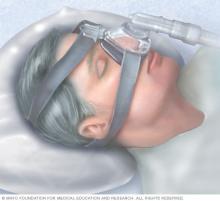
Positive airway pressure. If you have obstructive sleep apnea, you may benefit from positive airway pressure. In this treatment, a machine delivers air pressure through a piece that fits into your nose or is placed over your nose and mouth while you sleep.
Positive airway pressure reduces the number of times you stop breathing as you sleep. The therapy also reduces daytime sleepiness and improves your quality of life.
One of the most common types is called continuous positive airway pressure, also known as CPAP (SEE-pap). This treatment delivers continuous and constant pressure that is slightly stronger than the air pressure around you. The air pressure is just enough to keep your upper airway passages open so that you can breathe freely.
Although CPAP effectively treats obstructive sleep apnea, some people find the mask uncomfortable or loud. However, newer machines are smaller and less noisy than older machines. And there are a variety of mask designs for individual comfort.
Also, with some practice, most people learn to adjust the mask to obtain a comfortable and secure fit. You may need to try different types to find one that works well for you. Several options are available, such as nasal masks, nasal pillows or face masks.
If you're having trouble tolerating pressure, some machines have special adaptive pressure functions to improve comfort. You also might benefit from using a humidifier along with your CPAP system.
Another treatment option is autotitrating positive airway pressure, also called APAP. In CPAP, the pressure stays constant. The air pressure of an APAP varies, automatically adjusting when the device senses a change in airway resistance, such as the vibration of a snore. APAP can be helpful when the ideal fixed pressure for CPAP is difficult to identify — as is often the case during home sleep testing when no one is there to monitor your breathing patterns. There is less evidence supporting APAP compared with CPAP, but it seems to offer equivalent results.
Another type of positive airway pressure is bilevel positive airway pressure, also called BPAP. It's less commonly used than CPAP and APAP. BPAP delivers a preset amount of pressure when you breathe in and a different amount of pressure when you breathe out.
If you have stomach discomfort or bloating while using CPAP, check with your healthcare team to see what adjustments you can make to improve its comfort.
In addition, contact your healthcare team if you still snore or remain sleepy during the day despite treatment, if you begin snoring again, or if your weight changes by 10% or more.
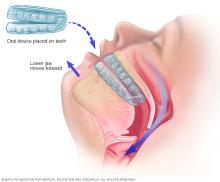
Mouth devices. Also known as oral appliances, these are an alternative for some people with mild or moderate obstructive sleep apnea. They're also used for people with severe sleep apnea who can't use CPAP. The devices may reduce sleepiness and improve quality of life.
All these devices are designed to keep the throat open. Some devices keep the airway open by bringing the lower jaw forward, which can sometimes relieve snoring and improve obstructive sleep apnea. Other devices hold the tongue in a different position to keep the airway free.
If you decide to explore this option, see a dentist experienced in dental sleep medicine appliances for the fitting and follow-up therapy. Several devices are available. Close follow-up is needed to ensure successful treatment and that use of the device doesn't cause changes to your teeth.
A newer device uses electrical stimulation on the tongue. A small number of studies show the device may help people with very mild sleep apnea and snoring. This device isn't meant to be used in place of CPAP if you have moderate to severe obstructive sleep apnea. It also is not recommended for people who have a pacemaker or another implanted electrical device.
Surgery or other procedures
Surgery is usually considered only if other therapies haven't been effective or don't fit your lifestyle. Surgical options may include:
- Surgical removal of tissue. Uvulopalatopharyngoplasty, also known as UPPP, is a procedure in which a surgeon removes tissue from the back of the mouth and top of the throat. The tonsils and adenoids may be removed as well. UPPP usually is performed in a hospital and requires a medicine that puts you in a sleeplike state. This medicine is called a general anesthetic. The goal of surgery is to correct any anatomic obstructions so that the upper airway stays open during sleep.
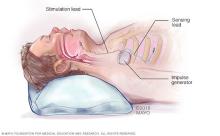
Nerve stimulation implant. This device is approved for use in people with moderate to severe obstructive sleep apnea who can't tolerate CPAP or BPAP.
A small, thin impulse generator, known as a hypoglossal nerve stimulator, is implanted under the skin in the upper chest. When you inhale, the device stimulates the nerve that controls the movement of the tongue. The tongue moves forward instead of moving backward and blocking the throat.
Studies have found that hypoglossal nerve stimulation greatly improves obstructive sleep apnea symptoms and quality of life.
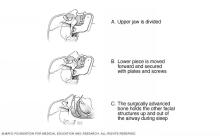
- Jaw surgery. In this procedure, the upper and lower parts of the jaw are moved forward compared with the rest of the facial bones. This enlarges the space behind the tongue and soft palate, making obstruction less likely. This procedure is known as maxillomandibular advancement.
Surgical opening in the neck, known as a tracheostomy. You may need this form of surgery if other treatments have failed and you have life-threatening obstructive sleep apnea.
During a tracheostomy, a surgeon makes an opening in the neck and inserts a metal or plastic tube for breathing. Air passes in and out of the lungs, bypassing the blocked air passage in your throat.
Other types of surgery may help reduce snoring and sleep apnea by clearing or enlarging air passages, including:
- Nasal surgery to remove polyps or straighten a crooked partition between the nostrils, called a deviated septum.
- Surgery to remove enlarged tonsils or adenoids.
- Bariatric surgery to shrink the size of the stomach and help you lose weight. Bariatric surgery can help improve symptoms of obstructive sleep apnea in people with obesity.
Weight-loss medications
Studies show that weight loss medications can help improve symptoms of obstructive sleep apnea. The U.S. Food and Drug Administration recently approved the weight-loss drug tirzepatide (Mounjaro, Zepbound), in combination with diet and exercise, for the treatment of moderate to severe obstructive sleep apnea.
Some people still may need treatment for obstructive sleep apnea after weight loss, although the symptoms are usually milder. Continue to work with your healthcare professional even if you lose a substantial amount of weight so that you're not missing out on any needed treatment.
Lifestyle and home remedies
In many cases, self-care may be the most appropriate way for you to deal with obstructive sleep apnea. Try these tips:
- Lose weight. If you're overweight or obese, even moderate weight loss may help relieve narrowing of your airway. Losing weight also can improve your health and quality of life and might reduce your daytime sleepiness.
- Exercise. Exercising, such as aerobic exercise and strength training, can help improve your condition. Aim to exercise about 150 minutes a week, and generally try to exercise most days of the week.
- Don't drink alcohol or use certain anti-anxiety medicines or sleeping pills. Alcohol, some anti-anxiety medicines and some sleeping pills can worsen obstructive sleep apnea and sleepiness.
Sleep on your side or stomach rather than on your back. Snoring may be loudest and apneas more common when you sleep on your back. Sleeping on your back can cause your tongue and soft palate to rest against the back of your throat and block your airway.
Devices that vibrate when you try to sleep on your back may help. These devices are usually worn around your neck or chest. Ask your healthcare professional if such a device might be appropriate for you. You also might try sewing a tennis ball in the back of your pajama top or place pillows behind you to keep you sleeping on your side.
- Keep your nasal passages open while you sleep. If you have congestion, use a saline nasal spray to help keep your nasal passages open. Talk to a member of your healthcare team about using nasal decongestants or antihistamines, because some medicines may be recommended for only short-term use.
Preparing for an appointment
If you suspect that you have obstructive sleep apnea, you'll likely first see your primary doctor or other healthcare professional. You might be referred to a sleep specialist.
Here's some information to help you get ready for your appointment.
What you can do
Be aware of pre-appointment requests. When you make your appointment, ask if there's anything you need to do in advance, such as keeping a sleep diary.
In a sleep diary, you record your sleep patterns such as bedtime, number of hours slept, nighttime awakenings and awake time. You also can record your daily routine, naps and how you feel during the day.
- Write down your symptoms, including any that may seem unrelated to the reason for your appointment, and when they began.
- Write down key personal information, including new or ongoing health concerns, major stresses, or recent life changes.
- Bring a list of all medicines, vitamins or supplements you take, including doses. Include anything you've taken to help you sleep.
- Take your bed partner along, if possible. Your partner can provide information about how much and how well you're sleeping. If you can't bring your partner with you, ask about how well you sleep and whether you snore and then share this information at your appointment.
- Write down your questions. Preparing a list of questions can help you make the most of your time during your appointment.
For obstructive sleep apnea, some basic questions to ask include:
- What's the most likely cause of my symptoms?
- What tests do I need? Do I need to go to a sleep clinic?
- What treatments are available and which do you recommend for me?
- I have other health conditions. How can I best manage these conditions together?
Don't hesitate to ask other questions.
What to expect from your doctor
A key part of the evaluation of obstructive sleep apnea is a detailed history, meaning your healthcare professional likely will ask you many questions. These may include:
- When did you first notice symptoms?
- Have your symptoms been off and on, or do you always have them?
- Do you snore? If so, does your snoring disrupt anyone else's sleep?
- Do you snore in all sleep positions or just when sleeping on your back?
- Do you ever snore, snort, gasp or choke yourself awake?
- Has anyone seen you stop breathing during sleep?
- How refreshed do you feel when you wake up? Are you tired during the day?
- Do you have a headache or dry mouth when you awaken?
- Do you doze off or have trouble staying awake while sitting quietly or driving?
- Do you nap during the day?
- Do you have family members with sleep disorders?
What you can do in the meantime
- Try to sleep on your side. Most forms of obstructive sleep apnea are milder when you sleep on your side.
- Don't drink alcohol close to bedtime. Alcohol makes obstructive sleep apnea worse.
- If you're drowsy, don't drive. If you have obstructive sleep apnea, daytime sleepiness can put you at higher risk of motor vehicle accidents. To be safe, schedule rest breaks. If a close friend or family member tells you that you appear sleepier than you feel, don't drive.
© 1998-2026 Mayo Foundation for Medical Education and Research(MFMER). All rights reserved. Terms of Use