Presbyopia
Conditions
Overview
Presbyopia is the gradual loss of your eyes' ability to focus on nearby objects. This natural, age-related change in vision usually begins sometime after age 40.
The first sign of presbyopia may be the need to hold printed materials at arm's length when reading. Presbyopia is typically corrected with reading glasses. Contact lenses, medicines and surgery also can correct near vision.
Symptoms
Presbyopia develops gradually. You may first notice these signs and symptoms after age 40:
- A tendency to hold reading material farther away to make the letters clearer.
- Blurred vision at a typical reading distance.
- Eyestrain or headaches after reading or doing close-up work.
When to see a doctor
See an eye doctor if blurry near vision keeps you from reading, doing close-up work or enjoying other everyday activities.
Seek immediate medical care if you:
- Have a sudden loss of vision in one eye with or without eye pain.
- Experience sudden hazy or blurred vision.
- See flashes of light, black spots or halos around lights.
- Have double vision.
The symptoms may indicate more-serious vision or health conditions.
Causes
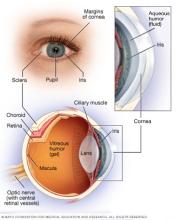
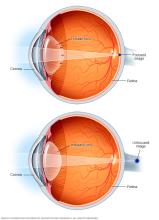
The cornea and lens of the eye bend light rays to meet at a single point on the back of the eye. This area, called the retina, translates the light into signals to the brain that allow a person to see a clear image.
The cornea is the clear, dome-shaped front surface of the eye. Its shape is fixed.
The lens is a clear structure about the size and shape of an M&M's candy. The lens is somewhat flexible and can change shape with the help of a circular muscle that surrounds it.
When you are looking at something in the distance, the muscle is relaxed. When you look at something nearby, the muscle contracts, making the lens more rounded. This ensures that light is still focused on a single point on the retina.
Presbyopia happens because the lens gradually becomes less flexible with age. This lack of flexibility causes light to reach the retina before it meets at a single point. As a result, nearby things, such as words on a page, look blurry.
Risk factors
The primary risk factor for presbyopia is age. Nearly everyone develops blurry near vision sometime after age 40.
Other factors may increase the risk of developing presbyopia before age 40. These include:
- Farsightedness.
- Long-term diseases such as diabetes, multiple sclerosis, and heart and blood vessel diseases.
- Prolonged work or reading at near distances.
- Medicines such as antidepressants, antihistamines and diuretics.
Diagnosis
Your eye doctor asks questions about your health and medical history and does a thorough exam of your eyes. These tests can show whether you have presbyopia or another condition affecting your vision. Tests may include:
- Vision test. A vision test, also called a visual acuity test, uses eye charts to measure how well you can read a series of letters. One eye is tested at a time while the other eye is covered. Your eye doctor determines how well you can see and what kind of corrective lenses you may need.
- Microscopic exam. Your eye doctor may use a specialized microscope to look at the outer eye and structures inside the eye. This exam is often done with a device called a slit lamp. This uses bright light and a microscope to see precise details of structures or changes in your eye. Your eye doctor looks at the condition of the optic nerve at the back of each eye. With this exam, you may have eye drops to enlarge your pupils.
- Intraocular pressure test. This measures the pressure inside your eye. There are multiple devices available to do this.
The American Optometric Association recommends that adults have a complete eye exam:
- Once a year or as recommended by a healthcare professional for adults with one or more risk factors for vision loss.
- At least every two years for adults age 64 or younger who have no risk factors for vision loss.
- Once a year or as recommended for adults 65 or older.
Treatment
The goal of treatment is to correct vision for reading and other close activities.
Eyeglasses
Eyeglasses are a simple way to correct blurry vision caused by presbyopia. You may be able to use nonprescription reading glasses, also called readers. Your eye doctor can recommend the correct power for you. You can test a pair of nonprescription readers on reading material held at a comfortable distance.
You will usually need prescription eyeglasses if you need a stronger lens or you already have prescription lenses for nearsightedness, farsightedness or astigmatism. Your choices include:
- Prescription reading glasses. If you need no other vision correction, you can use glasses with prescription lenses for reading only. You remove these when you're not reading.
- Bifocals. These lenses have a visible line that separates your distance prescription from your reading prescription.
- Trifocals. These glasses have corrections for close-up work, middle distance vision — such as for computer screens — and distance vision. Trifocals also have visual lines separating the different types of correction.
- Progressive multifocals. This type of lens has no visible horizontal lines. But it has multiple powers for distance, middle distance and close-up corrections. Different areas of the lens have different focusing strengths.
- Office or occupational progressives. These lenses have progressive corrections for middle distance work and reading. They do not correct distance vision for activities such as driving, recreation or everyday tasks.
Contact lenses
People with presbyopia who don't want to wear eyeglasses may try contact lenses to improve their near vision. Options include:
- Monovision contact lenses. With monovision contacts, you wear one contact lens for distance vision in your dominant eye. You wear a contact lens for close-up vision in the other eye. Using monovision contacts may affect your ability to judge the distance or speed of an object.
- Multifocal contact lenses. Multifocal contact lenses have two or more zones of correction. Your brain learns to select the correct focus. Some people find that the quality of vision with multifocal contact lenses is not as good as their vision with progressive prescription glasses.
Medicine
Pilocarpine (Isopto Carpine, Qlosi, Vuity) is a prescription eye drop to treat presbyopia. It improves close-up vision by decreasing the size of the pupil. The effect begins within 15 minutes and lasts for about six hours.
This treatment is approved in the United States for adults ages 40 to 55. Pilocarpine may increase the risk of retinal detachment and should not be used by people already at risk for this condition.
Aceclidine is another eye drop that was approved in 2025 for presbyopia. It works mainly on the pupil, which may lower the risk of side effects seen with pilocarpine. Early studies show that aceclidine can improve near vision for up to 10 hours. Most side effects of aceclidine are mild, such as temporary eye irritation or headache.
Surgery
Surgery may be used to correct presbyopia. Even after surgery, you may need to use readers for some close-up work. You might want to try monovision or multifocal contact lenses for a while before you commit to surgery.
Surgical procedures to correct presbyopia include:
- Laser-assisted in situ keratomileusis (LASIK). The surgeon uses a laser or blade to create a flap in the outer layers of the cornea. A laser is then used to reshape the part of the cornea that is exposed. The flap is then closed. The correction for presbyopia is made in the nondominant eye. Other needed vision correction is made in the dominant eye.
- Intraocular lenses. Intraocular lenses are artificial lenses placed inside the eyes. Different types of lenses — or combinations of lenses — may be used for near vision and other vision corrections.
- Corneal inlays. A corneal inlay is a tiny device that improves focus on near objects by changing how light passes through the cornea. The corneal inlay is inserted within the cornea of the nondominant eye.
Lifestyle and home remedies
You can't prevent presbyopia. You can help protect your eyes and your vision by following these tips:
- Have your eyes checked. Do this regularly even if you see well.
- Manage chronic health conditions. Certain conditions, such as diabetes and high blood pressure, can affect your vision if you don't receive proper treatment.
- Protect your eyes from the sun. Wear glasses or sunglasses that block ultraviolet (UV) radiation. This is especially important if you spend long hours in the sun or are taking a prescription medicine that increases your sensitivity to UV radiation.
- Prevent eye injuries. Wear protective eyewear when doing certain things, such as playing sports, mowing the lawn or using products with toxic fumes. Prescription glasses generally don't provide safety protection.
- Eat healthy foods. Try to eat plenty of fruits, leafy greens and other vegetables that provide important vitamins and antioxidants. Eat fish high in omega-3 fatty acids, such as salmon, tuna and halibut.
- Use the right glasses. The right glasses optimize your vision. Having regular exams helps ensure that your eyeglass prescription is correct.
- Use good lighting. Turn up or add light for better vision.
- Give your eyes a break. If you work at a computer, look away every 20 minutes at something about 20 feet away for 20 seconds.
Preparing for an appointment
If you're having difficulty with your vision, start by seeing an eye doctor, also called an optometrist or ophthalmologist. To make the most of your time with your eye doctor, it's a good idea to prepare for your appointment. Here's some information to help you prepare.
What you can do
- List symptoms you're having, including any that may not seem related to the reason for which you scheduled the appointment.
- Make a list of all medicines, vitamins and supplements you're taking, the doses of each, and the reason for taking each one.
- Consider taking along a family member or friend who drives. If your pupils are dilated for an exam, you will likely need someone else to drive you home. Your companion also can help remember information provided during your appointment.
- List questions to ask your eye doctor.
Preparing a list of questions can help you make the most of your time with your eye doctor. Some basic questions to ask regarding your vision include:
- What's the most likely cause of my symptoms?
- Are my medicines causing or worsening symptoms?
- Do I need any tests other than a complete eye exam?
- How often will I need eye exams?
- What treatments are available?
- What are the side effects or possible treatments?
- Which treatment would you recommend for me?
- If I have other eye conditions, how can I best manage these conditions together?
- Will drugstore reading glasses correct my near vision?
In addition to the questions that you've prepared, don't hesitate to ask additional questions that may occur to you during your appointment.
What to expect from your doctor
Your eye doctor is likely to ask you a number of questions, including some that relate to your general health, your medical history, your eye health history, your family medical history and your history of vision corrections. Your eye doctor may ask:
- When did you first begin having symptoms?
- Do your symptoms happen all the time or do they come and go?
- Do you do a lot of reading or other close-up work?
- Do you have eyestrain or headaches when reading or doing other close-up work?
What you can do in the meantime
Make sure you have plenty of lighting for tasks. If you don't currently wear prescription eyeglasses, try a pair of reading glasses you can get without a prescription.
© 1998-2026 Mayo Foundation for Medical Education and Research(MFMER). All rights reserved. Terms of Use