
Parathyroidectomy
Procedures
Overview
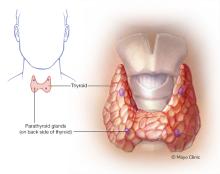
Parathyroidectomy (par-uh-thie-roid-EK-tuh-me) is surgery to remove one or more of the parathyroid glands or a tumor that's affecting a parathyroid gland.
There are four tiny parathyroid (par-uh-THIE-roid) glands, each about the size of a grain of rice. They sit behind the thyroid at the bottom of the neck. These glands make parathyroid hormone.
Parathyroid hormone helps keep the right balance of calcium in the bloodstream and in body tissues that need calcium to work well. Parathyroid hormone helps nerves and muscles work well and helps make bones healthy.
Parathyroidectomy often is done to treat overactive parathyroid glands, a condition called hyperparathyroidism (hi-pur-par-uh-THIE-roid-iz-um). Healthcare professionals don't always need to remove all the parathyroid glands to treat hyperparathyroidism.
Why it's done
You may need this surgery if one or more of your parathyroid glands make too much parathyroid hormone. This condition is called hyperparathyroidism. Hyperparathyroidism can cause you to have too much calcium in your blood. That can lead to weak bones, kidney stones, urinating too much and stomach pain, among other issues.
Primary hyperparathyroidism
Surgery is most often the treatment for primary hyperparathyroidism that causes symptoms. Primary hyperparathyroidism happens when one or more of the parathyroid glands are too active. A growth in a parathyroid gland that is not cancer is the most common cause. The growth is called an adenoma.
Primary hyperparathyroidism also can happen when the parathyroid glands are enlarged, called hyperplasia. A tumor that is cancer is a rare cause of primary hyperparathyroidism.
When the rise in blood calcium from primary hyperparathyroidism leads to symptoms, surgery is often the treatment. Surgery can lower the amount of calcium in the body. If you get primary hyperparathyroidism before age 50, your healthcare professional may suggest that you have surgery even if you don't have symptoms. When a tumor that's cancer causes primary hyperparathyroidism, surgery most often is the treatment.
Secondary hyperparathyroidism
Another form of hyperparathyroidism, called secondary hyperparathyroidism, sometimes needs treatment with surgery. Another medical condition such as kidney disease causes secondary hyperparathyroidism.
Treatment for the cause of secondary hyperparathyroidism may lower the calcium level and ease symptoms. If symptoms remain after treatment, your healthcare professional may advise parathyroidectomy.
Risks
Parathyroidectomy is most often safe. But as with any surgery, it carries a risk of complications.
Complications after surgery may include:
- Infection.
- A collection of blood, called a hematoma, under the skin of the neck that causes swelling and pressure.
- Long-term low calcium levels due to removing or damaging all four parathyroid glands.
- Lasting hoarse or weak voice due to damage to the nerves that manage the vocal cords.
How you prepare
You may need to stop eating or drinking for a time before surgery. Your healthcare professional tells you what to do. Before your surgery, arrange for a friend or family member to take you home after the procedure.
What you can expect
Before the procedure
You may have one of these imaging tests before surgery to find the parathyroid gland or glands that are too active:
- Sestamibi parathyroid scan. For this scan, you get a shot of sestamibi into a vein. Sestamibi is a radioactive dye that parathyroid glands absorb if they're too active. A scanner finds the dye. A healthcare professional may use CT scanning with the sestamibi scan to help make it easier to find issues with the parathyroid glands.
-
Ultrasound. Ultrasound uses sound waves to create pictures of your parathyroid glands and the tissue around them. A healthcare professional holds a small device called a transducer against your skin.
The transducer sends out high-pitched sound waves and records the sound wave echoes as they bounce off structures inside your body. A computer converts the echoes into pictures on a screen.
During the procedure
Parathyroidectomy uses general anesthesia. This means you're in a sleeplike state during the procedure.
The anesthetic medicine may be a gas that you breathe through a mask. Or you get the anesthetic medicine as a liquid that goes into a vein. You have a breathing tube in your windpipe to help you breathe during the procedure.
Surgeons use many approaches for parathyroidectomy. They include:
-
Bilateral neck exploration. This procedure involves making a cut, called an incision, in the center of your neck to get to your parathyroid glands. The surgeon finds all the parathyroid glands and removes the ones that are too active.
You most often have a blood test to measure parathyroid hormone during surgery. The results can confirm the removal of the parathyroid glands that are too active.
Rarely, all four parathyroid glands are too active. Then a surgeon likely removes only three glands and maybe part of a fourth. This helps keep the right level of calcium in your body after surgery.
- Minimally invasive surgery. A surgeon does this surgery most often when only one of the parathyroid glands is too active. It uses a smaller cut, called an incision, in the neck. Guided by the imaging tests done before surgery, the surgeon finds and removes the gland.
After the procedure
After surgery, some people may have neck pain and a hoarse or weak voice. This doesn't always mean there's lifelong damage to the nerve that manages the vocal cords. These symptoms often go away. The cause may be irritation from the breathing tube that's in the windpipe during surgery. Or the cause may be nerve irritation during surgery.
You'll likely be able to eat and drink as usual after surgery. Depending on the type of surgery you have, you may be able to go home on the day of your procedure. Some people need to stay overnight in the hospital.
When you go home, follow your healthcare professional's advice about when you may resume all your activities.
Results
Parathyroidectomy cures almost all cases of primary hyperparathyroidism and returns blood calcium levels to the standard range. Symptoms from too much calcium in the blood often go away after this procedure.
For some people, the stress of surgery means the body can't keep enough calcium. So calcium blood levels go below the standard range, called hypocalcemia. This condition most often lasts only a few days or a few weeks after surgery. Then blood calcium returns to the standard range.
Sometimes, hypocalcemia doesn't go away. Then you need to take calcium supplements long term.
© 1998-2026 Mayo Foundation for Medical Education and Research(MFMER). All rights reserved. Terms of Use